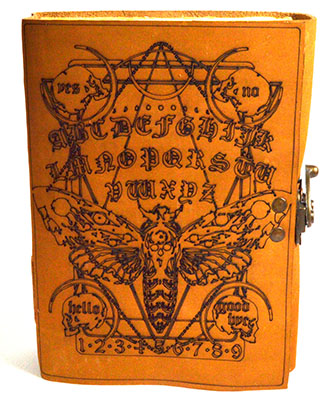
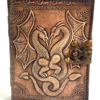
Moth & Ouija Board Leather Journal with Latch
$37.35
Talking Board And Night Moth
A leather journal with an Ouija board design and a large moth on the cover, aged-looking paper and a latch, made for spirit communication records and night work.
Quick Uses
- Séance log: Record every board session: who sat, what was spelled, what followed.
- Spirit book: Keep names and messages from the dead.
- Dream book: Write night visions straight after waking.
- Divination log: Track pendulum and card readings.
How to Use It
Witchcraft & Folk Magick
- Copy each spell out by hand before you cast it; writing it is part of charging it.
- Press herbs and flowers from your garden between the pages beside the spells that call for them.
Ceremonial & Occult Magick
- Copy talismanic seals and planetary squares with care, then consecrate the pages along with the book.
- Use it as a magickal record: date, planetary hour, rite performed and what you saw.
Demonology & Black Magick
- Log every board session or necromantic working: who came through, what they spelled, what offerings you gave and how you closed.
- Record dreams, visions and the events of each evocation straight after the rite, while they are fresh.
- Keep it as a private grimoire: the spirits you work with, their seals, the offerings they accept and when.
A Simple Working
- Light a white candle and a black candle side by side.
- Burn mugwort or wormwood.
- Open the book and write the date and the moon’s phase.
- Call on your beloved dead or a known spirit.
- Write any messages that come through planchette, pendulum or dream.
- Close by thanking the spirits and latching the book.
Pairs Well With
- Spirit board: The natural companion to this book.
- Pendulum: For quick yes or no questions.
- Wormwood: A traditional herb for spirit work.
- Black and white candles: For opening and closing sessions.
What You Receive
One leather journal with an Ouija board design and a large moth on the front cover, aged-looking paper and a latch closure.
Origin & Lore
Talking boards grew out of nineteenth-century Spiritualism, as faster tools for spelling out spirit messages than table-tipping. Moths, drawn to light at night, have long been seen as souls or messengers of the dead.
This book is made for keeping records of that kind of work.
Did You Know?
The Ouija board’s patent was filed in 1890 and granted in 1891, and the boards were first sold by the Kennard Novelty Company of Baltimore.
| Weight | 1.3 lbs |
|---|
Related products