

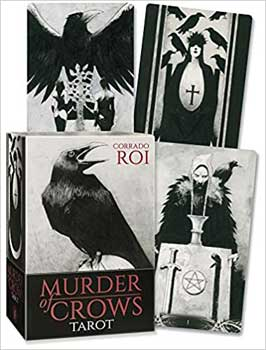
Murder of Crows Tarot by Corrado Roi
$29.65
Gothic Crow Omen Tarot
A 78-card tarot of crows in stark black and white by Corrado Roi, used by readers who want omens and honest answers, welcome or not.
Quick Uses
- Omen Reading: Ask a direct question and accept the card’s answer as the crows bring it.
- Necromantic Divination: Read at a grave or ancestor altar to hear from the dead.
- Hex Focus: Lay a card as the focal image of a curse or binding.
- Daily Draw: Pull one card a morning and watch for crows that day.
How to Use It
Witchcraft & Folk Magick
- Read when crows gather or call near your home, and note the card that comes.
- Leave a crow feather on a drawn card on your altar as a link to the messengers.
Ceremonial & Occult Magick
- Use a black-and-white trump as a gate for Saturnian meditation and scrying.
- Read on a Saturday in the hour of Saturn for questions of endings and fate.
Demonology & Black Magick
- Read before and after a necromantic working to learn who answered and what they want.
- Ask the crows, or a spirit of death, to choose a card as its reply, and record the terms with your offering.
- Lay the Tower or Death card at the centre of a hex worked with graveyard dirt and a black candle.
A Simple Working
- At dusk, light a black chime candle and burn a pinch of myrrh.
- Set out a small offering of seeds or bread for the crows on a windowsill or outside.
- Shuffle and ask your question plainly.
- Draw one card for the answer and one for what follows from it.
- Read them without softening the meaning.
- Leave the offering out overnight, record the reading, and watch for crows the next day.
Pairs Well With
- Myrrh resin: a heavy, funerary smoke for dark readings.
- Black chime candles: for omen and necromantic work.
- Crow feathers: as altar links to the messengers of the dead.
- Graveyard dirt: for laying a card into necromantic or hexing work.
What You Receive
One tarot deck of 78 cards in black and white, with a book.
Origin & Lore
Tarot began as a card game in Renaissance Italy and turned to divination from the 1780s. Crows and ravens have long carried omens: Odin’s ravens Huginn and Muninn brought him news of the world, and the Irish war goddess the Morrígan often appears as a crow over the battlefield.
Corrado Roi’s deck presents crows in gothic black and white as omen bringers and messengers, bringing the answers you need rather than the ones you hoped for.
Did You Know?
The phrase ‘a murder of crows’ comes from the fifteenth-century lists of collective nouns for animals and appears in the Book of Saint Albans, printed in 1486.
| Weight | 1.1 lbs |
|---|
Related products

Crystal Balls