

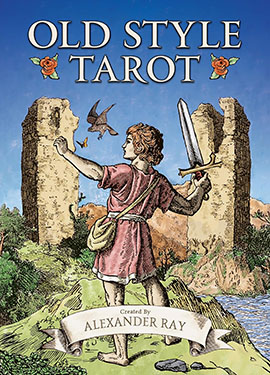
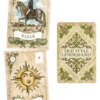
Old Style Tarot by Alexander Ray
$27.45
Vintage-Style Working Tarot
A 79-card tarot with vintage illustrations and clear traditional symbolism, made as a working deck for beginners and intuitive readers alike.
Quick Uses
- Daily card: Draw one card a morning and read the upright or reversed meaning.
- The blank card: Use the extra blank card as a wild card or an answer that is not yet written.
- Learning: Study one card each day with the guidebook until you know the deck.
- Quick answers: Draw one card for a fast answer and check the guidebook’s short reading.
How to Use It
Witchcraft & Folk Magick
- Read before a spell to see what the working needs.
- Use the deck at each sabbat to read for the coming season.
Ceremonial & Occult Magick
- Lay the Major Arcana out as a path for study of the Fool passing through the trumps and its occult correspondences.
- Use the blank card as your own symbol, drawn or sigilised, for workings that need a personal image.
Demonology & Black Magick
- Read before an evocation to judge timing and again afterwards to see what was stirred.
- Ask a spirit to answer through the deck, treating the blank card as a refusal to answer.
- Choose a card to lay as the image at the centre of a hex or a binding.
A Simple Working
- Light a white candle and burn frankincense.
- Shuffle while asking your question.
- Draw three cards: past, present and what comes next.
- Note which cards fall reversed.
- Read the guidebook’s advice for each card.
- Write the reading down and look back on it in a week.
Pairs Well With
- Frankincense – a general offering to clear the table.
- Velvet tarot bag – keeps the deck clean between readings.
- Tarot journal – to track readings over time.
- Clear quartz – laid on the deck to keep it charged.
What You Receive
One tarot deck of 79 cards, including one extra blank card, with a 104-page illustrated guidebook giving upright and reversed meanings.
Origin & Lore
Tarot was first a card game, played in fifteenth-century Italy, and took on its divinatory role in eighteenth-century France. Its vintage look in this deck nods to the old printed decks of Europe.
Alexander Ray designed this deck as a working tool, with clear symbols and an extra blank card for open questions.
Did You Know?
One of the oldest surviving decks of the Marseille pattern was printed in Paris by Jean Noblet around 1650, and its woodcut designs are still copied by modern deck makers.
| Weight | 1.1 lbs |
|---|
Related products