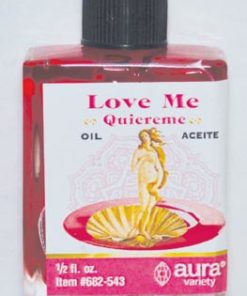


Oshun oil
Price range: $3.25 through $80.25
For the orisha of sweet rivers · Available in 3 sizes
An oil dedicated to Oshun, the orisha of sweet rivers, love, beauty and wealth, worked to draw lovers, money and a sweeter life.
Quick Uses
- Altar: dress a yellow candle and set it on her altar with a small dish of honey.
- Money: anoint five pennies or five cinnamon sticks and place them in a bowl of river water at her altar.
- Honey jar: dress a pink or yellow candle with the oil and a little honey to sweeten a lover or a boss.
- Attraction: wear a drop at the throat and wrists as a personal attraction oil.
How to Use It
Santería & Lucumí
- Dress a yellow candle with the oil and set it on her altar with a small dish of honey, tasting the honey first before offering it.
- Anoint five pennies or five cinnamon sticks and place them in a bowl of river water at her altar for money and sweetness.
- Add a few drops to a bath with honey and yellow flower petals before a date or important meeting.
Hoodoo & Rootwork
- Dress a pink or yellow candle with the oil and a little honey for honey-jar work to sweeten a lover or a boss.
- Wear a drop at the throat and wrists as a personal attraction oil.
A Simple Working
- Write the name of the person or the thing you want sweetened on a small square of paper.
- Place the paper in a small jar and cover it with honey, tasting a little honey yourself first.
- Add five drops of Oshun oil and close the jar.
- Dress a yellow chime candle with the oil from wick to base and stand it on the lid.
- Light the candle and speak plainly to Oshun about what you want, then let it burn down.
- Repeat on four more days, five in all, then keep the jar on her altar.
Pairs Well With
- Honey: her best-known offering and the base of sweetening jars.
- A yellow chime candle: her colour, for dressing with the oil.
- Cinnamon sticks: a common offering and money ingredient in her work.
- Oranges: a traditional fruit offering for Oshun.
What You Receive
Oshun oil, available in 2 dram, 1 oz and 16 oz.
Origin & Lore
Oshun (Ọ̀ṣun) is the orisha of the Osun River in south-west Nigeria, owner of fresh water, love, fertility, sweetness and gold. In Cuban Lucumí she is syncretised with Our Lady of Charity of El Cobre, the patroness of Cuba, and her colours are yellow and gold with the number five. This oil is a botánica preparation used to honour her and to carry her sweetness into love and money work.
Before offering honey to Oshun, many devotees taste it first: in the old story she was once offered poisoned food, and tasting the honey shows her it is safe.
The Osun-Osogbo Sacred Grove, a forest on the banks of the Osun River in Nigeria, is one of the last surviving sacred groves of Yorubaland and hosts a festival for Oshun every August. In a Lucumí patakí, when the orishas stopped honouring Olodumare and drought came, Oshun flew to heaven as a peacock to beg for rain; the sun burned her feathers until she arrived as a vulture, and the rain was returned.
Did You Know?
The Osun-Osogbo Sacred Grove was named a UNESCO World Heritage Site in 2005.
| Weight | N/A |
|---|---|
| Size | 2 dram, 1 oz, 16 oz |
Related products