


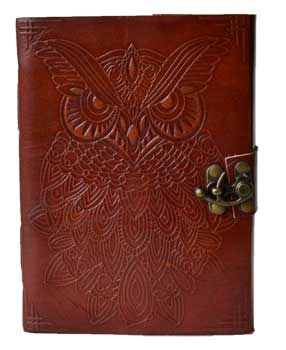
Owl Leather Blank Book with Latch
$20.85
The Owl’s Book of Night Wisdom
A hand-tooled leather blank book with an embossed owl and linen parchment pages, kept for study notes, night work and divination records.
Quick Uses
- Study Book: Take notes on the texts and teachers you learn from.
- Divination Log: Record readings with date, question and outcome.
- Night Notes: Write down what comes to you in the late hours, when owls are hunting.
- Grimoire: Copy your proven spells onto the parchment pages.
How to Use It
Witchcraft & Folk Magick
- Keep it as a study grimoire, gathering herb lore, charms and correspondences.
- Write down omens from owls heard or seen, with date and place.
Ceremonial & Occult Magick
- Record your reading of the old texts, with quotes and your own commentary.
- Keep a ritual diary for each working.
Demonology & Black Magick
- Log questions put to spirits and the answers received through cards, pendulum or vision.
- Draft sigils and seals on the parchment pages and keep the finals together.
A Simple Working
- On a Wednesday evening, light a white candle and a little sandalwood or frankincense.
- Pass the closed book through the smoke three times.
- Open to the first page and write a dedication to study and true sight.
- Write the first question you most want to understand this year.
- Draw a tarot card or rune for it and write the answer beneath.
- Close the latch and keep the book where you study.
Pairs Well With
- A rune set or tarot deck, for divination entries.
- Sandalwood incense, for study and night work.
- A labradorite stone, often kept for intuition and night sight.
- A dip pen and ink, which suit the parchment paper.
What You Receive
One leather blank book with a tooled and embossed owl at centre front. The back cover carries diagonal tooling and the spine edge has leather cross-stitching. Closes with a brass-coloured metal latch. Measures 5″ x 7″ with 240 unlined pages of handmade linen parchment paper.
Origin & Lore
The witch’s blank book began as a study book: the place to copy what you learned from teachers and older texts, much as Renaissance magicians compiled commonplace books of extracts from Agrippa, Ficino and the classics.
The owl was the bird of Athena, goddess of wisdom, in ancient Greece, while in much European folklore its cry at night was heard as an omen.
Did You Know?
Ancient Athenian silver tetradrachm coins carried Athena’s owl on one side, and they were so common that ‘owls’ became slang for the coins themselves.
| Weight | 1 lbs |
|---|
Related products


