


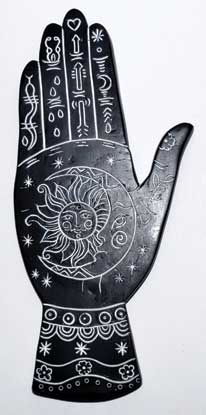
Palmistry Hand Incense Burner (7 1/2″)
$12.05
The Palmist’s Hand for Readings
A flat 7 1/2″ slate-coloured hand incense burner with detailed palmistry symbols and a stick hole at the centre of a sun and moon image, kept by readers who want their incense to rise from the palm itself.
Quick Uses
- Reading Table Smoke: Burn a stick in it beside you while you read palms or cards.
- Study Aid: Keep it on your desk as a map of the mounts and lines as you learn.
- Seer’s Offering: Burn incense in it to honour the spirits who guide your readings.
How to Use It
Witchcraft & Folk Magick
- Burn a stick of mugwort or sandalwood in it before each reading to open your sight.
- Lay your own hand beside it and compare the lines as part of a self-reading.
Ceremonial & Occult Magick
- Burn the incense of the planet whose mount you are studying, such as frankincense for the Sun.
- Use it on a divination altar alongside your cards, pendulum or crystal.
Demonology & Black Magick
- Burn a stick in it as an offering to a spirit of divination before asking what is hidden.
- Hold your palm over the smoke and ask a familiar spirit to speak through your readings.
A Simple Working
- On a Wednesday, the day of Mercury, light a yellow chime candle.
- Light a stick of mugwort or sandalwood incense in the hand.
- Hold your left hand over the smoke for a few breaths, then your right.
- Study your own palm, starting with the heart, head and life lines.
- Note what the sun and moon on the burner bring to mind about your outer and inner self.
- Record what you see in a journal and keep it with the burner.
Pairs Well With
- Mugwort Incense: A seer’s herb for opening the inner eye.
- Yellow Chime Candles: For Mercury and the reading arts.
- Palmistry Book: To learn the lines and mounts in depth.
- Tarot Deck: For readers who combine palms and cards.
What You Receive
One flat, solid, slate-coloured hand incense burner, 7 1/2″ long, with detailed symbols and a stick incense hole in the centre of a sun and moon image.
Origin & Lore
Palmistry, or chiromancy, is the art of reading character and fortune from the lines and shape of the hand, and the hand image on this burner draws on it. It was practised in ancient India and is discussed in Greek writings, and it was widely taught in medieval and Renaissance Europe.
In Western palmistry the fleshy areas of the hand are called mounts and named after the planets, such as the Mount of Venus at the base of the thumb and the Mount of Jupiter below the index finger. The Irish palmist known as Cheiro made the art famous in the late 1800s and early 1900s.
Did You Know?
In Western palmistry the fleshy pad at the base of the thumb is called the Mount of Venus.
Related products


