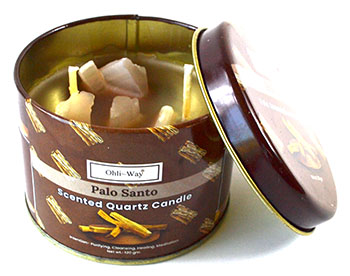
Palo Santo Quartz Tin Candle
$10.95
Holy Wood for Purification
A palo santo scented candle set with quartz crystal chips in a lidded tin, lit for purification, blessing and quiet meditation.
Quick Uses
- Meditation Light: Light it before you sit in meditation to settle your mind.
- Purify Tools: Pass tarot cards, crystals or pendulums over the tin while it burns.
- Blessing: Burn it in a room you want to bless and make sacred.
How to Use It
Witchcraft & Folk Magick
- Light it to cleanse your altar before a new working, then lay your tools around it.
- Burn it at the end of a long day to clear your space and settle your spirit.
Hoodoo & Rootwork
- Light it while you wipe down your altar and doorways with a cleansing wash.
- Burn it after a quarrel in the house to clear the air and restore calm.
Ceremonial & Occult Magick
- Use it as the purifying light during the consecration of new ritual tools.
- Burn it before scrying or trance work to quiet the mind.
Demonology & Black Magick
- Burn it before and after spirit work to keep your working room clean.
- Light it to purify the space where you will lay out a spirit’s sigil.
A Simple Working
- Choose a quiet evening and lay a clean white cloth on your altar.
- Set the candle in the centre and light it.
- Hold each of your tools briefly over the warmth of the flame.
- Say aloud that each tool is cleansed and ready for work.
- Sit in silence for ten minutes, breathing in the palo santo scent.
- Snuff the candle and put the lid on until your next cleansing.
Pairs Well With
- Palo Santo Sticks: To smoke cleanse alongside the candle.
- White Chime Candles: For quick consecration spells.
- Selenite: A purifying stone to keep near tools.
- Florida Water: A classic cleansing cologne for altars and hands.
What You Receive
One palo santo scented candle with quartz crystal chips, poured in a tin with a lid. Each candle weighs 120 g.
Origin & Lore
Palo santo, Spanish for holy wood, comes from Bursera graveolens, a tree of the dry forests of South America. Its first use was cleansing: the fragrant wood has long been burned in Andean and coastal South American folk practice to clear spaces, people and objects of bad energy.
The wood is valued most when it comes from fallen branches left to age, which gives it the rich, sweet scent. It belongs to the same plant family as frankincense and myrrh, the classic sacred resins of the ancient world.
Did You Know?
Palo santo belongs to the same plant family, Burseraceae, as frankincense and myrrh.
Related products