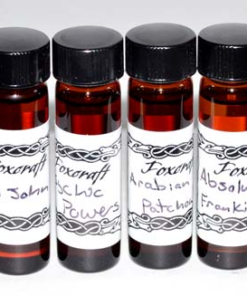
Pan oil
Price range: $3.25 through $80.25
For the goat-footed god of the wild · Available in 3 sizes
An oil dedicated to Pan, the goat-footed Greek god of the wild and untamed desire, worked for lust, vitality and contact with spirits of wild places.
Quick Uses
- Lust: dress a red or green candle and burn it outdoors or by an open window.
- Wild places: anoint yourself before a woodland ritual to honour the spirits of the place.
- Altar: add a drop to a pan pipe, horn or pine cone kept on his altar.
- Invocation: anoint the forehead and heart before reciting Crowley’s Hymn to Pan.
How to Use It
Witchcraft & Folk Magick
- Dress a red or green candle with the oil and burn it outdoors or by an open window for lust and vitality.
- Anoint yourself before a ritual held in woodland or open country to honour the spirits of the place.
- Add a drop to a pan pipe, a horn or a pine cone kept on an altar to him.
Ceremonial & Occult Magick
- Anoint the forehead and heart before reciting an invocation such as Aleister Crowley’s “Hymn to Pan”.
- Dress a candle at the start of Beltane or other fertility rites in which Pan is honoured as the horned god of nature.
A Simple Working
- Go outdoors at dusk with a red chime candle, a small cup of milk and the oil.
- Dress the candle with the oil from base to wick to draw desire toward you.
- Stand it in the earth and light it.
- Pour the milk on the ground as an offering to Pan.
- Say aloud what you want to feel or draw in your body and your life.
- Let the candle burn out and bury the stub where it stood.
Pairs Well With
- A red chime candle: for lust and vitality.
- Milk: an old offering to the shepherd god.
- Pine cones: for an outdoor altar to him.
- Patchouli oil: for earthy attraction work alongside his.
What You Receive
Pan oil, available in 2 dram, 1 oz and 16 oz.
Origin & Lore
Pan was the god of shepherds, flocks, mountain pasture and the wild, born in Arcadia in the Greek Peloponnese and shown with the legs and horns of a goat. He was worshipped in caves and open country rather than great temples, with offerings of milk, honey and young animals. This oil is a modern blend used to honour him and to call up his earthy, unashamed energy.
Our word “panic” comes from Pan: the sudden, groundless terror that could sweep through a herd or an army was blamed on the god of the wilds.
According to Plutarch, a sailor named Thamus was ordered by a voice from the shore to announce that “Great Pan is dead”, a story later read as marking the end of the pagan gods. Pan was revived in the nineteenth and twentieth centuries by poets and occultists as a figure of nature and liberation, and Crowley’s “Hymn to Pan” was published in 1919.
Did You Know?
Herodotus records that Pan appeared to the runner Pheidippides before the Battle of Marathon, and the Athenians afterwards founded a shrine to him below the Acropolis.
| Weight | N/A |
|---|---|
| Size | 2 dram, 1 oz, 16 oz |
Related products