



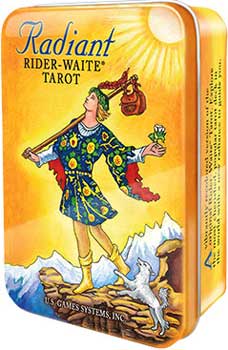
Radiant Rider-Waite Tarot in a Tin
$21.95
Pocket Radiant Rider-Waite in Tin
The Radiant Rider-Waite tarot, Pamela Colman Smith’s classic art in brighter colours, in a pocket size and keepsake tin for readings anywhere.
Quick Uses
- Travel: Carry the tin in a bag for readings away from home.
- Daily card: Draw one card each morning and keep it on your desk.
- Learning: Use the classic symbols to learn tarot through the standard deck.
- Altar: Keep the tin on your altar with a stone or herb on top.
How to Use It
Witchcraft & Folk Magick
- Read before spells or at sabbats, using the classic symbols most books are written for.
- Keep a single card in the tin with herbs as a pocket charm.
Ceremonial & Occult Magick
- Use the deck as the base for Golden Dawn correspondences of the Major Arcana.
- Carry it for rites away from your home temple.
Demonology & Black Magick
- Ask a spirit to answer through the cards in the circle, with the tin closed on the altar until called for.
- Read before and after evocation or graveyard work.
- Lay a card such as the Tower or the Devil as the focal image of a hex.
A Simple Working
- Light a white candle and burn frankincense.
- Open the tin and shuffle the deck.
- Draw three cards for past, present and future.
- Read the symbols in each card.
- Note the reading in your journal.
- Return the cards to the tin and lay a sprig of rosemary on the lid overnight.
Pairs Well With
- Rosemary – to keep the tin fresh and clear.
- Tarot journal – for tracking readings.
- Frankincense – a clean offering for any reading.
- Clear quartz – laid on the tin to keep the deck charged.
What You Receive
One Radiant Rider-Waite tarot deck of 78 pocket-sized cards measuring 2″ x 3.5″, with star-filled blue sky backs, an instruction booklet with an introduction by Stuart R. Kaplan, and a keepsake tin.
Origin & Lore
Tarot was a card game in fifteenth-century Italy before it turned to divination in eighteenth-century France. The Rider-Waite deck of 1909, drawn by Pamela Colman Smith to the plan of A. E. Waite, became the standard for English-speaking readers.
The Radiant edition keeps Smith’s designs and adds a brighter palette and fine shading.
Did You Know?
Pamela Colman Smith’s Minor Arcana scenes owe a debt to the Sola Busca tarot of around 1490, the only early deck with fully illustrated pip cards, whose photographs went on show at the British Museum in 1907.
| Weight | 0.5 lbs |
|---|
Related products





Altar Supplies