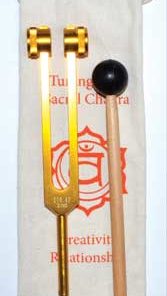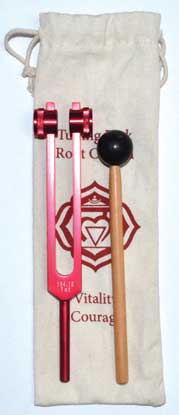
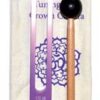
Red Root Chakra Tuning Fork (8 1/2″)
$53.85
A red fork tuned to the root centre
An 8 1/2″ root chakra tuning fork stamped 194.18 Hz, struck and held near the base of the spine to tune your energy for grounding, stability and security in meditation and ritual.
Quick uses
- Grounding: sound it after ritual to return to earth.
- Stability: use it in home and protection rites.
- Strength: build courage before hard work.
In stock
How to Use It
Divination & Spirit Work
- Strike the fork before a reading to clear the air and settle the root centre.
- Hold it near the base of the spine while you meditate on grounding, stability and security.
- Let the tone fade completely before you ask your first question.
Witchcraft & Folk Magick
- Strike it while burying a protection jar to root the spell in place.
- Sound it near the floor in a new home to settle the house.
- Use it to ground yourself after spellwork.
Ceremonial & Occult Magick
- 194.18 Hz is one of the planetary tones of the Cosmic Octave, where it is given to the Earth day.
- Sound it in the day or hour of the Earth day to open a planetary working.
- Strike it at each quarter as you cast the circle, letting the tone mark the boundary.
Demonology & Black Magick
- Ground yourself with its tone before and after an evocation.
- Strike the fork before an evocation to clear the space of stray influences.
- Sound it again after the license to depart to close the rite cleanly.
- Sound it during necromantic work to keep your feet among the living.
A Simple Working
- Sit quietly and take three slow breaths.
- Strike the fork gently with the mallet.
- Hold it near the base of the spine and listen until the tone fades.
- State your intention for grounding, stability and security aloud.
- Repeat three times, then sit in silence and record what you felt.
Pairs Well With
- Red candles: to match the chakra.
- Red jasper: to set on the altar while you sound it.
- Other chakra tuning forks: to work through all seven centres.
- Meditation cushion: for longer sessions.
- Journal: to record your impressions.
What You Receive
One 8 1/2″ root chakra tuning fork stamped 194.18 Hz, with a 7″ mallet.
Origin & Lore
Tuning forks began as tools for musicians, giving a pure, steady pitch that could be carried anywhere.
In the late twentieth century the Swiss mathematician and musicologist Hans Cousto calculated tones from the orbits of the planets, and energy workers took them up for chakra and ritual work. 194.18 Hz belongs to the Earth day in that system.
Did You Know?
Hans Cousto derived 194.18 Hz from the length of one Earth day, the planet’s turn on its own axis.
| Weight | 0.30 lbs |
|---|
Related products

All Herbs