



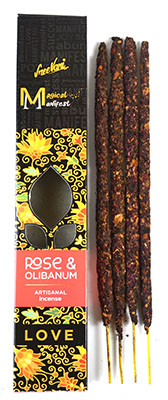
Rose & Olibanum Love Manifest Incense Sticks (4 Pack)
$5.45
Rose and Frankincense for Love
Four artisan sticks blending sweet rose with earthy olibanum, a pairing burned to sanctify love workings and invite tender attraction.
Quick Uses
- Love Petition: Light a stick while writing out the qualities of the partner you seek.
- Date Night: Burn one in the room an hour before a romantic evening.
- Love Altar: Offer a stick on Friday to a deity of love.
How to Use It
Witchcraft & Folk Magick
- Burn it during a waxing moon spell to call in true love.
- Smoke a pair of red ribbons before tying them in a love knot.
- Burn a stick while charging a love charm under the full moon.
Hoodoo & Rootwork
- Burn a stick over a love-drawing candle dressed with rose petals.
- Use it to bless a sweetening jar before adding honey.
- Light one as you anoint a pink candle with rose oil.
Ceremonial & Occult Magick
- Use it in a Venusian ritual where rose honours Venus and frankincense consecrates the space.
- Burn it while consecrating a talisman of love.
- Burn it during a Friday prayer to a deity of love before any love working.
Demonology & Black Magick
- Offer the smoke to a spirit of love as a sweet and sacred gift.
- Smoke a love sigil before placing it under a pink candle.
A Simple Working
- Place a pink chime candle on a dish scattered with dried rose petals.
- Light the candle and one rose and olibanum stick.
- Hold your hands in the smoke and speak the qualities of the love you seek.
- Gather a pinch of the petals and wrap them in a small square of red cloth.
- Let the candle and stick burn out.
- Carry the petal bundle with you until your next new moon.
Pairs Well With
- Pink Chime Candles: For gentle attraction and romance.
- Dried Rose Petals: A classic love ingredient for altars and charms.
- Rose Quartz: Charged in the smoke as a love stone.
- Frankincense Resin: Burn on charcoal to deepen the consecration.
What You Receive
One pack of four artisan incense sticks scented with rose and olibanum.
Origin & Lore
Rose has been a flower of love since ancient Greece and Rome, where it was sacred to Aphrodite and Venus. Olibanum is frankincense, the resin of Boswellia trees, first and foremost a temple offering burned in Egypt, Arabia, Jerusalem and Rome.
Pairing the two brings love work into consecrated space: rose for the heart and frankincense for blessing and making the working sacred.
Did You Know?
The word olibanum is generally traced through Medieval Latin to the Arabic al-luban, meaning the milk, after the milky sap of the frankincense tree.
Related products


