



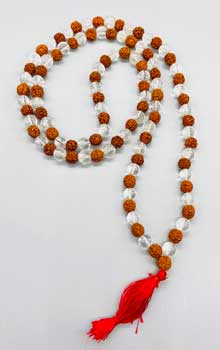
Rudraksha and Quartz Japa Mala
$26.35
Shiva’s Seeds And Clear Quartz
A prayer mala of rudraksha seeds spaced with clear quartz, for counting mantras and chants and carrying devotion through the day.
Quick Uses
- Mantra Count: Move one bead per recitation to keep count of a mantra or chant.
- Daily Wear: Wear it to keep your practice with you outside the shrine.
- Shrine Offering: Lay it before your altar image when it is not in use.
How to Use It
Witchcraft & Folk Magick
- Count repetitions of a chant or spell verse, one bead for each, so you never lose the number.
- Lay it in a circle around a candle as a protective ring during work.
Ceremonial & Occult Magick
- Use it to count repetitions of a divine name or invocation in a set number.
- Consecrate it with incense and water before first use and keep it only for prayer.
Demonology & Black Magick
- Count repetitions of a spirit’s enn or name, keeping an exact number across nightly sessions.
- Wear it as a protective string during spirit work, then return it to the shrine afterwards.
A Simple Working
- Sit before a candle and a stick of sandalwood incense.
- Hold the mala in your right hand.
- Begin at the bead next to the head bead.
- Recite your chosen mantra once per bead.
- When you reach the head bead, turn the mala back rather than crossing it.
- Close by touching the mala to your forehead.
Pairs Well With
- Sandalwood Incense: Traditional for Shiva and prayer.
- Clear Quartz Point: A larger stone for the shrine.
- White Candles: For daily devotion.
- Mala Bag: Keeps the beads clean between uses.
What You Receive
One japa mala of rudraksha seed beads spaced with clear quartz beads. Natural seeds and stones vary in size, shape and colour. From India.
Origin & Lore
Rudraksha beads are the dried seed stones of Elaeocarpus trees. The name joins Rudra, an epithet of Shiva, and aksha, eye, and Hindu legend says the trees grew from Shiva’s tears. They have been strung as prayer beads for centuries by devotees of Shiva.
Clear quartz was believed by ancient Greek writers to be ice frozen so hard it could never melt, and its name comes from the Greek krystallos, ice.
Did You Know?
Rudraksha seeds are graded by mukhi, the number of natural grooves on the seed, and five-mukhi beads are by far the most common.
Related products


