

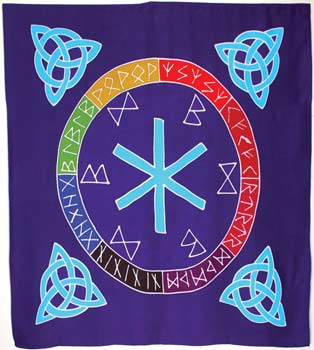
Rune Mother Batik Altar Cloth (36″ x 36″)
$52.75
A Runic Altar for Divination
A hand-dyed Balinese batik cloth with the Mother Rune at its centre and the runic alphabet circling it, made for rune casting and Norse altar work.
Quick Uses
- Rune Casting: Spread it on a table and cast your runes onto it, reading where they fall in relation to the centre.
- Norse Altar: Dress your altar with it for rites honouring the Norse gods and ancestors.
- Scarf Ward: Wear it as a scarf to carry the runes with you on the day of a reading or ritual.
How to Use It
Witchcraft & Folk Magick
- Use it as a casting cloth: stones or runes landing near the centre speak to the heart of the matter.
- Wrap your rune set or tarot deck in it between readings.
Ceremonial & Occult Magick
- Lay it as the ground for runic talisman work, setting the talisman over its rune while you colour and charge it.
- Meditate on each rune of the outer ring in turn, chanting its name to learn the row.
Demonology & Black Magick
- Use it as the base of an altar for spirit contact, placing the spirit’s offering at the centre.
- Draw a bind rune for a binding or protective spell and set it at the centre before charging.
A Simple Working
- On a Wednesday, spread the cloth on a table and light a blue or white candle.
- Hold your rune set and breathe on it, asking your question aloud.
- Cast the runes onto the cloth.
- Read the runes nearest the Mother Rune first as the core of the answer.
- Read those near the edge as outside influences.
- Thank the runes, gather them and fold them into the cloth.
Pairs Well With
- Elder Futhark Rune Set: To cast and read on the cloth.
- Mugwort Incense: For opening the sight before readings.
- Blue Chime Candles: For wisdom and divination work.
- Norse Drinking Horn: To hold offerings on a Norse altar.
What You Receive
One handmade batik altar cloth or scarf from Bali, Indonesia, 36″ x 36″, with the Mother Rune at the centre, a ring of runic letters, and a triquetra in each corner.
Origin & Lore
Runes were first an alphabet for writing the early Germanic languages, and were also used in charms, inscriptions and casting lots. The Roman historian Tacitus described Germanic peoples cutting a branch into slips, marking them and casting them onto a white cloth to read the will of the gods.
The Mother Rune is an idea from early twentieth-century German rune mysticism, a single figure from whose lines all the other runes can be drawn. Batik, the wax-resist dyeing seen in this cloth, is an Indonesian craft recognised by UNESCO as an intangible cultural heritage.
Did You Know?
Tacitus wrote in 98 CE that Germanic diviners cast marked wooden slips onto a white cloth to read omens.
Related products


