


Sacred Circle Tarot by Franklin & Mason
$28.59
Pagan Britain and Ireland in Tarot
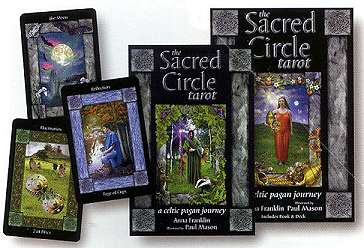
A 78-card tarot built from photographs and drawing of the sacred sites of Britain and Ireland, with a Major Arcana reworked for Pagan practice, used by readers who want the old landscape in their spreads.
Quick Uses
- Seasonal readings: Read a full spread at each sabbat to take stock of the turning year.
- Meditation: Gaze on The Green Man or The World Tree before trance work to settle the mind.
- Land work: Draw a card at a standing stone or holy well and note what the place says through it.
- Spell planning: Draw one card to choose the theme for the next moon’s working.
How to Use It
Witchcraft & Folk Magick
- Read at the sabbats and esbats, laying the spread inside your cast circle.
- Choose a card that shows the outcome you want and set it under a candle for the length of a spell.
Ceremonial & Occult Magick
- Use the cards as meditation and pathworking images, which is exactly what the deck’s layered photography was designed for.
- Map The Druid and The World Tree onto your own ritual structure as keys for invocation.
Demonology & Black Magick
- Read before an evocation to divine which spirit to approach and whether the hour is right.
- Lay a card as the focal image of a curse or binding, naming it as the shape the working should take.
- Draw again after the rite to read how the spirit received it.
A Simple Working
- Cast a circle and light a green candle in the north.
- Burn a little frankincense and pass the deck through the smoke.
- Take The Green Man from the deck and place it face up before the candle.
- Shuffle the rest and draw three cards for the land, the self and the path ahead.
- Sit with each card in silence before reading it.
- Record the spread in your journal.
- Open the circle and pour a little water on the earth outside.
Pairs Well With
- Frankincense resin: a classic for consecrating a new deck.
- A green chime candle: for land and growth workings with a chosen card.
- A reading cloth: keeps the cards clean on altar or outdoor stone.
- Oak or rowan wood: a token of the Celtic trees to rest the deck on.
What You Receive
One tarot deck of 78 cards with an instructional booklet. Deck only.
Origin & Lore
Tarot began in fifteenth-century northern Italy as a card game, the trionfi, played with an added suit of picture trumps. Its use as a tool for reading fate grew in eighteenth-century France and was shaped into the system most readers know by the occult orders of the late nineteenth century.
The Sacred Circle Tarot draws on the sacred sites and Pagan heritage of Britain and Ireland, combining photographs, digital imaging and drawing. Its Major Arcana is adapted to the Pagan theme: The Fool becomes The Green Man, The Hierophant becomes The Druid and The World becomes The World Tree.
Did You Know?
The Celtic Cross, the most widely used ten-card spread, was popularised by A. E. Waite, who printed it in 1910 as “An Ancient Celtic Method of Divination”.
| Weight | 0.8 lbs |
|---|
Related products