


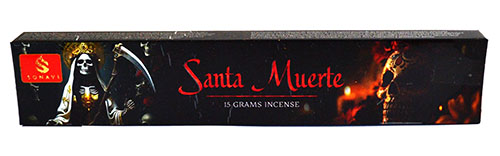
Santa Muerte incense sticks
Price range: $3.25 through $9.85
A smoke offering for the Bony Lady · Available in 2 sizes
Stick incense for the altar of Santa Muerte, burned as a smoke offering when petitioning her for protection, love, money and justice.
Quick Uses
- Daily offering: light a stick before her image each morning, greet her by name and change her water.
- Petitions: pass your written request through the smoke while saying it aloud, then leave it beneath her statue.
- Colour work: burn it with a candle in the colour of your request, such as red for love or gold for money.
- Cutting work: fan the smoke over a photograph or scythe-shaped paper to sever a person, habit or bond.
How to Use It
Folk Catholicism & Spiritism
- Daily offering: light a stick before her image each morning or on the first of the month, greet her by name and change her water when you do.
- Petition smoke: write your request on paper, set it under her statue and pass the paper through the smoke while you say it aloud, then leave it beneath her until it is answered.
- Colour work: burn the incense alongside a candle in the colour of the request, white for cleansing and protection, red for love, gold for money, black for protection against enemies and for harder work.
Demonology & Black Magick
- Black-robed workings: devotees who ask her to stop or punish an enemy burn the incense with a black candle and a written name, and speak to her plainly about what was done to them.
- Cutting work: the smoke is fanned over a scythe-shaped cut of paper or a photograph to sever a person, a habit or a bond.
A Simple Working
- Set her image on a clean cloth with a glass of fresh water.
- Light a white seven-day candle and greet her as you would an elder.
- Light one incense stick from the candle flame and let it smoke in front of her.
- Pass your hands through the smoke and ask her to stand between you and harm.
- Leave a red apple or a single rose as thanks.
- Repeat the stick each day the candle burns, and take the fruit outside when it begins to soften.
Pairs Well With
- Santa Muerte statue: a focus for daily offerings.
- White seven-day candle: for protection and cleansing petitions.
- Black seven-day candle: for work against enemies.
- Tequila: one of her best-known offerings.
- Incense burner: to keep the ash off her altar cloth.
What You Receive
Santa Muerte stick incense, available as a single 15 g pack or as a box of 6 hexagon packs with 20 sticks each (120 sticks).
Origin & Lore
Santa Muerte is a Mexican folk saint, a personification of holy death venerated outside the official Church. Her devotion moved from private homes into the street in 2001, when Enriqueta Romero set up a life-sized figure outside her house in the Tepito district of Mexico City. Devotees keep her with candles, flowers, tequila, cigarettes and incense, and smoke is one of the simplest daily gifts.
She wears a bridal gown or a hooded robe, carries a scythe and a globe, and is called by pet names: la Flaquita, the Skinny One; la Niña Blanca, the White Girl. Few saints are spoken to so familiarly, and fewer still are this unapologetically death.
Inquisition records from late eighteenth-century Mexico describe indigenous people venerating a skeletal figure, which historians often cite as an early trace of the devotion. Some writers link her to Mictecacihuatl, the Aztec lady of the underworld, though that connection is debated. Her iconography borrows from European images of death: the scythe of the Grim Reaper, the scales of judgement, and an owl at her feet.
Did You Know?
In 2013 Cardinal Gianfranco Ravasi, head of the Vatican’s Pontifical Council for Culture, publicly condemned the devotion to Santa Muerte as blasphemous.
| Weight | N/A |
|---|---|
| Option | 15 g, Box of 6 packs |
Related products


