


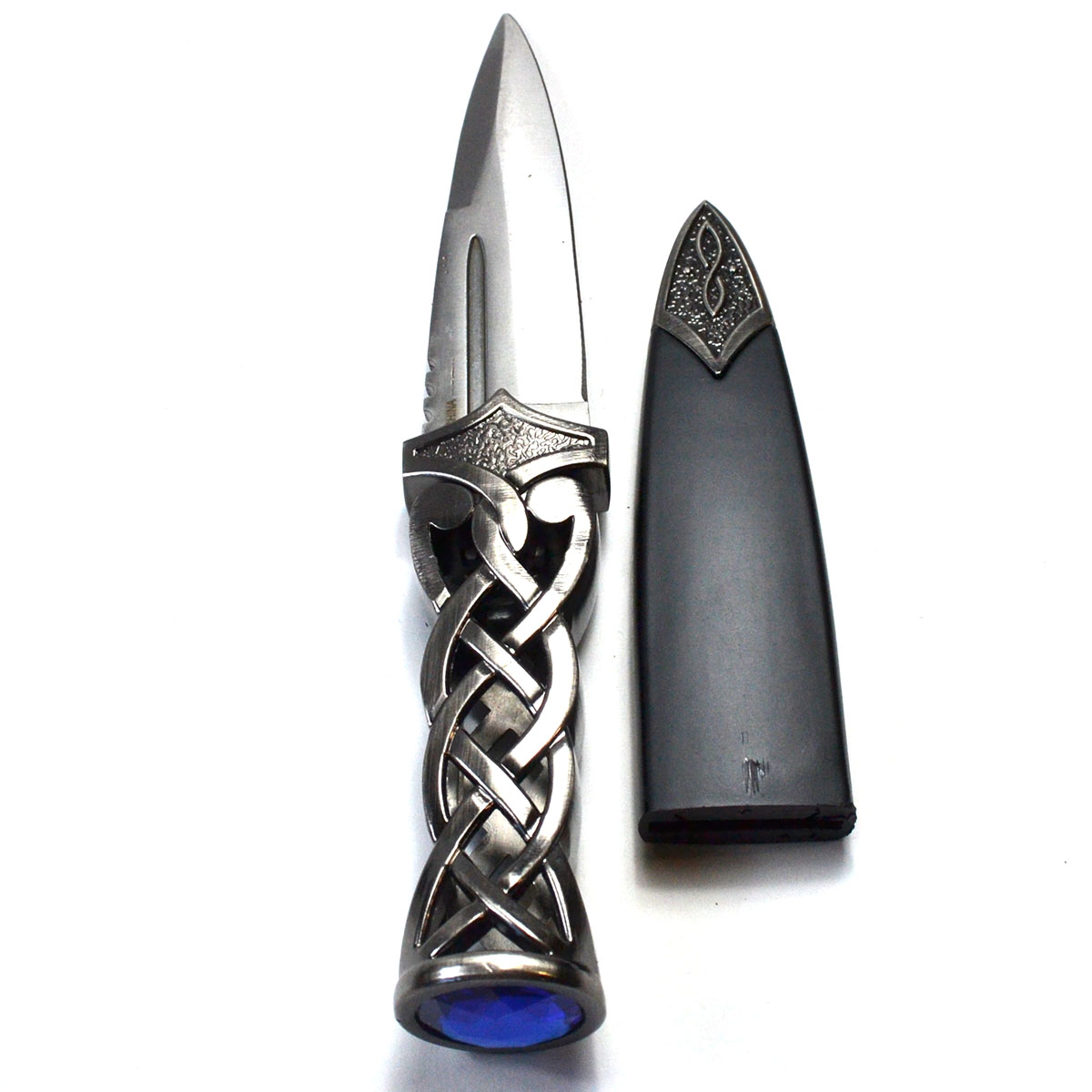
Scottish Highland Athame with Scabbard (8 1/2″)
$42.85
A Highland Blade for Ritual
A Scottish-style short ritual sword with a fullered steel blade and blue-stoned handle, chosen by witches who want a commanding, regal blade on the altar.
Quick Uses
- Circle Casting: Draw your circle with the full length of the blade for a strong, clear boundary.
- Ancestral Altar: Lay it before a Scottish or Celtic ancestor shrine as a sign of honour.
- Oath Blade: Swear an oath with your hand on the hilt and keep it sheathed until the oath is kept.
How to Use It
Witchcraft & Folk Magick
- Use it to cast the circle at the sabbats, walking sunwise with the point held at waist height.
- Lay it in its scabbard across the altar to mark the space as closed and guarded when you are not working.
Ceremonial & Occult Magick
- Take it up as the sword of the magician, the tool of Air and of the discerning will, in banishing and opening rites.
- Point it at each quarter in turn while vibrating divine names to seal the temple.
Demonology & Black Magick
- Hold it drawn during evocation as the operator’s sword, the sign of command over the spirit called.
- Lay it point toward the triangle of art to keep the spirit within its bounds while terms are spoken.
- Use the point to strike through a written enemy’s name in a cutting or hexing rite.
A Simple Working
- On a Tuesday, light a red chime candle and some dragon’s blood incense.
- Draw the athame from its scabbard and hold it up to the flame.
- Pass the blade through the smoke and name it as your sword of protection.
- Walk once around your space with the point outward.
- Return to the altar and touch the blade to the candle’s base.
- Sheathe it and leave it on the altar until the candle burns down.
Pairs Well With
- Red Chime Candles: For courage and strength workings with the blade.
- Dragon’s Blood Resin: A classic incense for empowering ritual blades.
- Celtic Altar Cloth: To set the blade on a fitting ancestral altar.
- Protection Oil: To dress the hilt before major rites.
What You Receive
One Scottish-style athame with a fixed stainless steel blade with a fuller (blood groove), a polished stainless steel handle set with a blue stone, measuring 9″ overall, with a hard scabbard.
Origin & Lore
The athame is the witch’s ritual knife, traditionally used to cast the circle, direct will and command the elements rather than to cut anything physical. Its form draws on the knives of the Scottish Highlands, the long dirk and the small sgian-dubh, which were worn as everyday arms and marks of status.
The groove running along the blade is properly called a fuller. Popularly nicknamed a blood groove, it was made to lighten and stiffen the blade.
Did You Know?
The ‘blood groove’ on a blade is really a fuller, made to lighten and strengthen the steel, not to let blood flow.
Related products


