



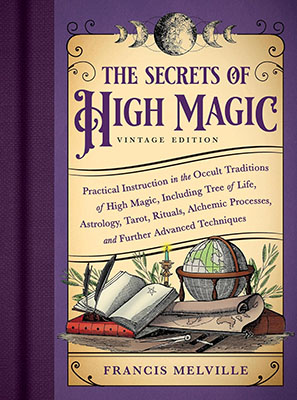

Secrets of High Magic (Vintage Edition) by Francis Melville
$20.89
A Primer In High Magick
A compact illustrated survey of ceremonial magick, from altar building and talismans to alchemy, tarot, geomancy and the I Ching.
Quick Uses
- Altar Setup: Follow its altar guidance to build a working space before your first formal rite.
- Divination Practice: Try one method a week, geomancy, I Ching or tarot, and record each reading.
- Talisman Making: Use it as a starting point for making and consecrating your first talisman.
How to Use It
Ceremonial & Occult Magick
- Build your altar to its pattern and work one consecration rite on it before using it for anything else.
- Cast a geomantic chart on a question, then check it against a tarot spread on the same question.
Witchcraft & Folk Magick
- Read the alchemy section on a Saturday and journal what each stage means in your own life.
- Use the I Ching on a full moon question and keep the hexagram on your altar until the next.
Demonology & Black Magick
- Study its overview of spirit conjuration before you approach any grimoire spirit, so you know the classical framework.
- Consecrate a talisman for protection before any evocation and wear it through the rite.
A Simple Working
- On a Sunday morning, clean your altar and lay a white cloth.
- Light a white pillar candle and burn frankincense.
- Draw a simple sigil for your aim on parchment.
- Pass it through the smoke four times, once for each element.
- State its purpose aloud and fold it in three.
- Keep it on your body or under the candle for seven days.
Pairs Well With
- Frankincense Resin: The standard incense of solar and consecration rites.
- Parchment Paper: For sigils, seals and talismans.
- Tarot Deck: To practise the divination it covers.
- Altar Cloth: To set your working space apart.
What You Receive
One copy of Secrets of High Magic by Francis Melville, vintage edition. A 5.75″ x 7.75″ paperback with 144 pages.
Origin & Lore
This book gives a wide, practical tour of the high magickal tradition: conjuring spirits, ritual divination, the making and consecrating of talismans, and work with other planes. It also takes in altar building, tarot, alchemy, geomancy and the I Ching, making it a good map before you specialise.
High or ceremonial magick grew from learned Renaissance sources such as Marsilio Ficino and Cornelius Agrippa, whose Three Books of Occult Philosophy appeared in full in 1533. It was later systematised by orders like the Hermetic Order of the Golden Dawn in the 1880s and 1890s.
Did You Know?
Western geomancy works with sixteen figures, each built from four rows of either one or two dots.
Related products


