


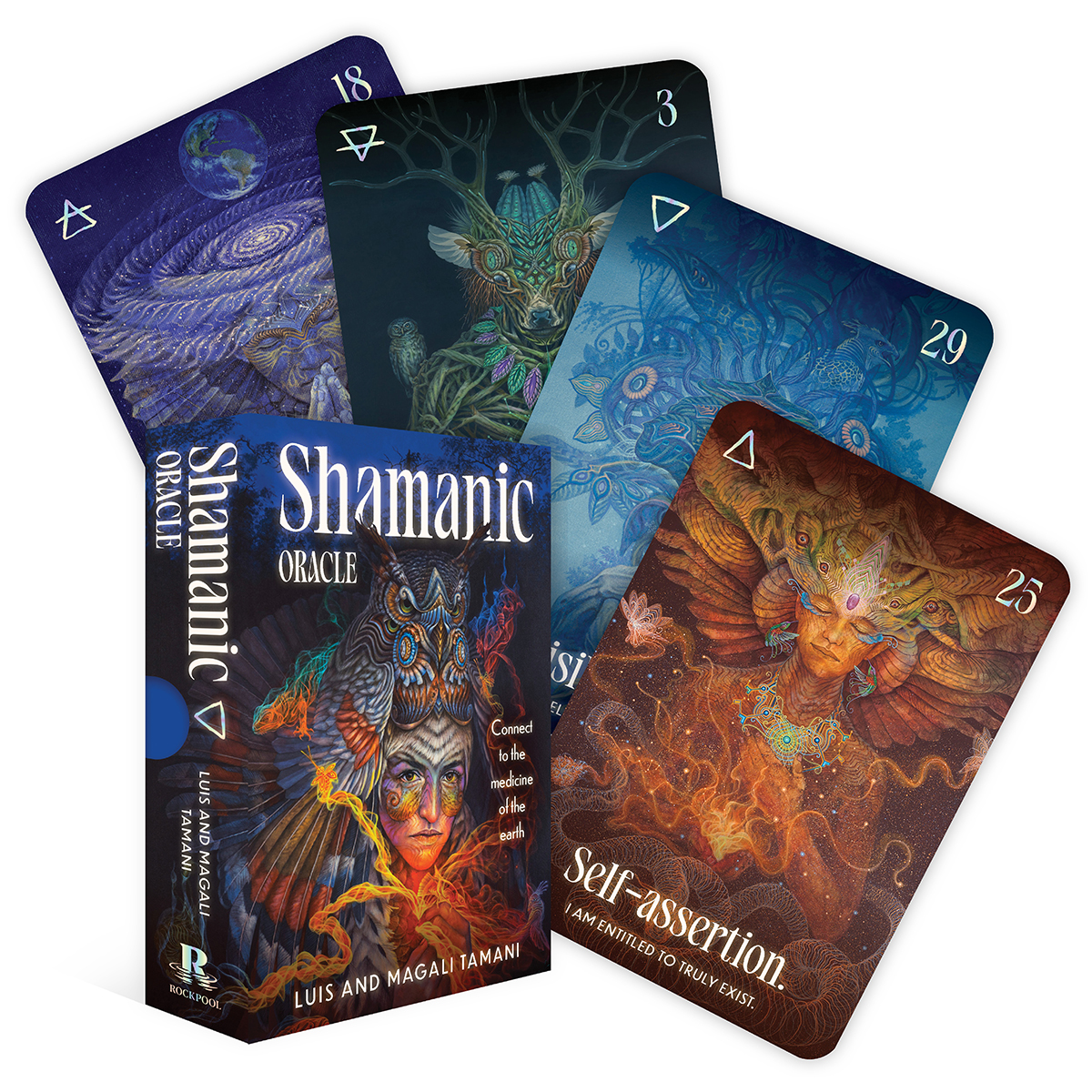


Shamanic Oracle by Tamani & Tamani
$29.65
Visionary Art of the Living Earth
An oracle illustrated by Peruvian visionary artist Luis Tamani, with vivid images of nature and spirit that act as mirrors for self-understanding and reconnecting with the earth.
Quick Uses
- Nature reading: Take the deck outdoors and draw a card sitting on the ground.
- Trance focus: Gaze on a card before drumming or trance work as a doorway image.
- Dream work: Place a card under your pillow and record what comes in the night.
- Daily mirror: Draw one card each morning and ask what it shows of you.
How to Use It
Witchcraft & Folk Magick
- Read outdoors, in a garden or wood, for questions of healing and connection to the land.
- Lay a drawn card at the foot of a plant you are asking for help before harvesting.
Ceremonial & Occult Magick
- Use the visionary images as gateways in meditation and spirit journeying.
- Draw a card before dream work and lay it under the pillow as a focus.
Demonology & Black Magick
- Draw to divine which spirit of land or nature to approach before an evocation.
- Read before and after a working with an earth spirit to see how it was received.
A Simple Working
- Sit on bare earth or by a houseplant with the deck.
- Burn a little copal or sage and pass the cards through the smoke.
- Breathe slowly until your mind is quiet.
- Shuffle and draw one card.
- Gaze at the image for several minutes and note what you feel and see.
- Leave a small offering of water or tobacco for the land.
Pairs Well With
- Copal resin: a traditional resin of the Americas for clearing and offering.
- A frame drum or rattle: for trance work with a chosen card.
- Mugwort: for dream work with a card under the pillow.
- A reading cloth: to keep the cards clean outdoors.
What You Receive
One oracle deck illustrated by Peruvian artist Luis Tamani.
Origin & Lore
Oracle decks descend from the fortune-telling cards that spread through Europe from the late eighteenth century: packs with their own fixed images and meanings, free of the 78-card tarot structure, made to be read directly for omens and counsel.
This deck is illustrated by the Peruvian artist Luis Tamani, whose vivid, visionary images centre on nature and the light that runs through people and the earth. The cards are made to act as mirrors, opening the reader to self-understanding and reconnection.
Did You Know?
The word “shaman” comes from the Evenki, a Tungusic people of Siberia, and reached European languages through Russian travellers’ accounts in the seventeenth century.
| Weight | 0.9 lbs |
|---|
Related products