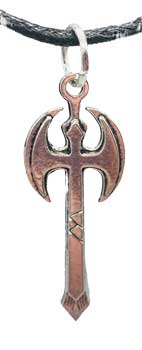
Shango Double Axe Amulet
$3.25
The Thunder King’s Double Axe
A small pendant of the double-headed axe of Shango, the orisha of thunder, lightning and fire, carried by devotees and practitioners who honour his strength and sense of justice.
Quick Uses
- Devotional Charm: Wear it as a sign of respect and connection to Shango.
- Altar Token: Place it on a red and white altar cloth as part of an offering space.
- Courage Piece: Carry it in a pocket into confrontations where you need nerve.
- Justice Charm: Keep it with your papers when facing a legal battle.
How to Use It
Witchcraft & Folk Magick
- Set it on a red cloth beside a red candle during storms to honour the power of thunder.
- Carry it as a charm of personal fire and courage when you must stand up for yourself.
Hoodoo & Rootwork
- Lay it on court papers beneath a red candle dressed with court case oil.
- Keep it in a red mojo bag with a lightning-struck wood sliver for strength and victory.
Ceremonial & Occult Magick
- Work it in the day and hour of Mars for rites of strength and decisive action.
- Hold it during visualisation of lightning splitting an obstacle in two.
Demonology & Black Magick
- Wear it as a sign of a powerful spiritual protector when doing aggressive spirit or justice work.
- Keep it on your working altar during reversal and return-to-sender work, as a reminder that what is unjust is struck down.
A Simple Working
- On a Saturday, the day often given to Shango, cover a small table with a red and white cloth.
- Light a red candle and set the amulet before it.
- Offer a red apple or a pinch of cinnamon beside it.
- Speak plainly about the situation where you need courage or fair judgment.
- Let the candle burn while you sit with the flame for a few minutes.
- Wear the amulet afterward and take the apple outside to a tree when you are done.
Pairs Well With
- Red Chime Candles: Shango’s colour for quick offerings and petitions.
- Cinnamon Sticks: A warm, fiery spice for strength workings.
- Court Case Oil: For dressing candles in legal matters.
- Red and White Beads: Shango’s colours for an altar or a devotional charm.
What You Receive
One Shango double axe amulet pendant, approximately 1 1/2″ long.
Origin & Lore
The double-headed axe, called the oshe Shango, is the emblem of Shango, the Yoruba orisha of thunder, lightning, fire, drumming and dance, and it marks his presence in shrines and ceremonies.
In Yoruba tradition Shango is remembered as a king of the Oyo Empire who became an orisha. Carried across the Atlantic by enslaved Yoruba people, his worship lives on in Cuban Lucumí (Santería), where he is spelled Changó and has long been syncretised with Saint Barbara, and in Brazilian Candomblé, where he is known as Xangô.
Did You Know?
Shango’s sacred colours are red and white, and his devotees often wear beaded necklaces in alternating red and white.
Related products