


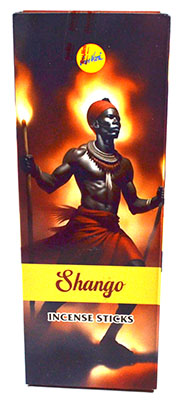
Shango incense sticks
$9.85
Thunder smoke for strength and justice
Stick incense for Shango, Orisha of thunder, fire and justice, burned at his shrine for strength, victory, passion and fair judgement.
Quick Uses
- Victory: light a stick before his shrine with a red and white candle when facing an opponent or hard test.
- Justice: burn it with a written statement of the facts in a dispute, asking him to judge fairly.
- Passion: burn it with a red candle and apples for vitality and desire.
- House protection: burn a stick at the front door on Saturdays and smoke a red ribbon to hang above it.
How to Use It
Santería & Lucumí
- Strength and victory: light a stick before his shrine with a red and white candle when you face an opponent, a fight or a hard test.
- Justice: burn it with a written statement of the facts in a dispute, asking him, as a king, to judge fairly and strike down lies.
- Passion: he is a lover as well as a warrior, so his incense is burned with a red candle and apples for vitality and desire.
Folk Catholicism & Spiritism
- Saint Barbara: light the incense before her image, crowned and holding a sword and chalice, on 4 December or during storms, asking her protection from sudden harm.
- Protection of the house: burn a stick at the front door on Saturdays and pass red cloth or a red ribbon through the smoke to hang above the door.
A Simple Working
- Place a red candle and a white candle side by side.
- Set six apples or a single red apple in front of them.
- Write the matter you need to win on paper and lay it under the fruit.
- Light both candles and one stick of Shango incense.
- Speak to him boldly and directly, the way you would speak to a king.
- When the candles finish, take the fruit to the foot of a large tree.
Pairs Well With
- Red and white candles: in his colours.
- Saint Barbara candle: for those who honour him through his saint.
- Apples: a favourite offering.
- Double axe pendant: his emblem, to carry for courage.
What You Receive
Shango stick incense, a box of 6 hexagon packs with 20 sticks in each (120 sticks).
Origin & Lore
Shango (Changó) is the Yoruba Orisha of thunder, lightning, fire, drumming and dance, remembered as the fourth Alaafin (king) of Oyo. His colours are red and white, his emblem is the double-headed axe, and in Cuba he is syncretised with Saint Barbara, whose feast falls on 4 December. Devotees keep him with apples, bananas, red wine and drums.
He was a king before he was a god. Shango ruled the Yoruba city of Oyo, called lightning down on his enemies, and when he left the world his followers cried “Oba ko so”: the king did not hang.
Oral history says that Shango’s reign over Oyo ended in turmoil and that he hanged himself, after which his enemies mocked him. Storms and lightning then struck the city, and his followers declared “Oba ko so”, the king did not hang, proclaiming that he had ascended to become an Orisha. Kosó is still part of his praise names.
Did You Know?
In Yorubaland, prehistoric stone axe heads turned up in fields were traditionally called edun ara, thunderstones, and were believed to be the bolts Shango hurled to earth.
| Weight | 0.8 lbs |
|---|
Related products


