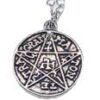
Solomon’s Seal Amulet
$17.55
The Ring-Seal of King Solomon
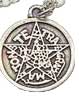
A small silver toned pendant of Solomon’s Seal, the legendary sign said to have given King Solomon command over spirits, worn by magicians as a mark of authority and protection.
Quick Uses
- Spirit Ward: Wear it during any spirit work as a sign of command and protection.
- Wisdom Charm: Wear it during study, writing or decision-making.
- Sealing Tool: Press it on wax over a spell jar or letter to seal the working.
- Home Guard: Hang it near the front door on its chain.
How to Use It
Witchcraft & Folk Magick
- Press it into the warm wax of a sealed spell jar to lock the working.
- Wear it as a ward when visiting places with restless spirits.
Hoodoo & Rootwork
- Keep it on top of a written command or domination petition under a purple candle.
- Carry it in a mojo bag for wisdom and success in matters of authority.
Ceremonial & Occult Magick
- Consecrate it in the hour of the Sun and wear it as a seal of the magician’s authority.
- Meditate on it as an emblem of the union of opposites in Hermetic thought.
Demonology & Black Magick
- Wear it during evocation as a sign of Solomon’s command over spirits, reminding the spirit by whose authority it is called.
- Lay it on the sigil of a bound spirit to seal an agreement once terms are reached.
A Simple Working
- On a Sunday at sunrise, light a gold or yellow candle.
- Burn a little frankincense and hold the pendant in the smoke.
- Speak the name of King Solomon and ask for wisdom and command in your work.
- Drip a little candle wax onto a square of paper and press the pendant gently into it to leave the seal.
- Keep the sealed paper on your altar as the charter of your work.
- Wear the pendant whenever you do spirit work.
Pairs Well With
- Frankincense Resin: The resin of the Sun and of Solomonic consecration.
- Gold Candles: For solar workings of authority.
- Purple Candles: For command and domination petitions.
- Sealing Wax: To seal workings with the pendant.
What You Receive
One silver toned Solomon’s Seal pendant, approximately 1″, attached to a 22 1/2″ chain.
Origin & Lore
Solomon’s Seal began as a legendary signet ring said to have been given to King Solomon by God, letting him command demons and jinn.
The Testament of Solomon, a pseudepigraphal text from the early centuries AD, tells how Solomon used the ring to compel demons to help build the Temple in Jerusalem. In Jewish, Christian and Islamic lore the seal is drawn as a hexagram or a pentagram, and it was carved on amulets, doorways and coins across the medieval world.
Did You Know?
The plant called Solomon’s seal takes its name from the seal-like scars on its rootstock.
Related products