

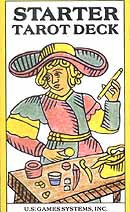

Starter Tarot Deck by Bennett & George
$24.14
Learn Tarot From the Cards
A 78-card beginner’s tarot with revised motifs and both upright and reversed meanings printed on every card, so the reader can learn while reading.
Quick Uses
- First readings: Read straight from the meanings printed on each card.
- Reversals: Practise reversed meanings without reaching for a book.
- Daily study: Draw one card each morning and learn it by heart.
- Spell check: Pull a card before a working to see if the time is right.
How to Use It
Witchcraft & Folk Magick
- Draw a card before each spell to check timing and approach.
- Lay the card showing the outcome you want under a candle for the length of the working.
Ceremonial & Occult Magick
- Use the printed meanings to build a solid base before moving to more symbolic decks.
- Keep a daily draw log to learn the cards in your own words.
Demonology & Black Magick
- Read before and after a working with a spirit to learn how readings track ritual outcomes.
- Draw one card per question when asking a spirit to speak through the deck.
A Simple Working
- Light a white chime candle.
- Shuffle the deck while thinking of one clear question.
- Draw three cards for past, present and future.
- Read the printed meaning on each card, upright or reversed.
- Write the meanings in your own words in a notebook.
- Check back in a week to see how the reading played out.
Pairs Well With
- A white chime candle: for clear, simple readings.
- A blank journal: for a daily card log.
- A reading cloth: to mark out your reading space.
- A tarot guidebook: for depth once the basics are learned.
What You Receive
One tarot deck of 78 cards with upright and reversed meanings printed on each card, and an instructional booklet.
Origin & Lore
Tarot began in fifteenth-century northern Italy as a card game, the trionfi, played with an added suit of picture trumps. Its use as a tool for reading fate grew in eighteenth-century France and was shaped into the system most readers know by the occult orders of the late nineteenth century.
This deck is designed for beginners, with revised tarot motifs and the interpretations and reversed meanings printed on each card.
Did You Know?
The Tarot de Marseille, the pattern behind most French and Italian decks for centuries, was printed from carved woodblocks and coloured by hand through stencils.
| Weight | 0.6 lbs |
|---|
Related products