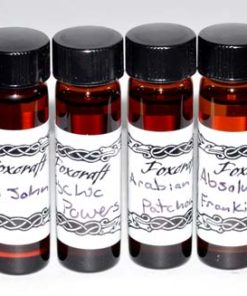
Success oil
Price range: $3.25 through $80.25
A condition oil for goals and careers · Available in 3 sizes
A condition oil for success in goals, career, studies and new ventures, dressed on candles, résumés, business cards and charms.
Quick Uses
- Candle dressing: dress a gold or yellow candle on a Sunday, the day of the Sun, for recognition.
- Bay leaves: write your goal on a bay leaf, anoint it and carry it until the goal is reached.
- Applications: dress résumés, business cards and applications before sending them.
- Interviews: touch a drop to your hands before an interview or important meeting.
How to Use It
Witchcraft & Folk Magick
- Dress a gold or yellow candle on a Sunday, the day of the Sun, for recognition.
- Write your goal on a bay leaf, anoint it and carry it until the goal is reached.
- Anoint the corner of a vision board or written plan.
Hoodoo & Rootwork
- Dress résumés, business cards and applications before sending them.
- Anoint a mojo bag of bay leaves, cinnamon and High John root.
- Touch a drop to your hands before an interview or important meeting.
Ceremonial & Occult Magick
- Consecrate a talisman of the Sun drawn in the day and hour of the Sun.
- Anoint the forehead before solar invocations for confidence and authority.
A Simple Working
- On a Sunday, take a gold or yellow chime candle and a square of parchment.
- Write your goal at the top of the paper and three concrete steps toward it below.
- Dress the candle with Success oil from base to wick.
- Anoint the four corners and the centre of the paper.
- Set the candle on the paper and light it, reading your goal aloud.
- Let it burn out and keep the paper where you work.
Pairs Well With
- Bay leaves, the laurel of ancient victors, for writing goals.
- Cinnamon, for speed and warmth in success work.
- Citrine, carried for confidence and prosperity.
- Gold candles, for solar recognition.
- High John the Conqueror oil, when you need to overcome obstacles.
What You Receive
Success oil, available in 2 dram, 1 oz and 16 oz bottles.
Origin & Lore
Success oil belongs to the Crown of Success and Success family of hoodoo condition oils, made for advancement, recognition and getting ahead. It is a general working oil for any goal you are actively pursuing, from a promotion to a creative project.
The Greeks crowned the victors of the Pythian Games at Delphi with laurel, and success magick has never really let go of that image.
Crown of Success and plain Success formulas were staples of mid-century hoodoo catalogues and are still standard condition oils today. They draw on solar symbolism that runs from Greek laurel wreaths to the gold of royal crowns.
Did You Know?
The word “laureate”, as in poet laureate or Nobel laureate, comes from the Latin laureatus, crowned with laurel.
| Weight | N/A |
|---|---|
| Size | 2 dram, 1 oz, 16 oz |
Related products