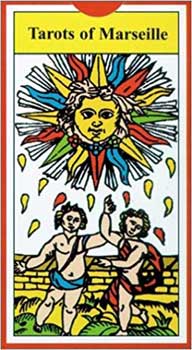

Tarot of Marseille by Claude Burdel
$26.35
The Classic French Pattern
A detailed reproduction of a classic Marseille-pattern deck, the family of cards that first drew the French occultists and set tarot on its path as a divination tool.
Quick Uses
- Traditional reading: Read the Majors pictorially and the pips by number and suit, the old Marseille way.
- Daily trump: Draw one Major Arcana card each day and sit with its symbolism.
- Ancestral reading: Read with this deck when asking questions of ancestors who knew the older European tradition.
- Study deck: Compare its images against a modern RWS deck to see where later symbolism came from.
How to Use It
Witchcraft & Folk Magick
- Read the pip cards by number and suit as earlier European cartomancers did, without relying on scenes.
- Use a single trump as a focus image for a candle spell matched to its meaning.
Ceremonial & Occult Magick
- Work with the Majors as the 22 letters and paths the 19th-century French occultists built onto the Marseille images.
- Meditate on one trump per day across the 22 to learn the pattern at its root.
Demonology & Black Magick
- Read before and after a working to judge whether a spirit has been received well and what it wants.
- Lay the Devil, the Tower or Death as the central image of a hex or a pact working, as the stark Marseille woodcut style suits that kind of work.
- Divine which spirit to approach by drawing from the Majors alone.
A Simple Working
- Set out a black chime candle and a white chime candle side by side.
- Light frankincense and pass the deck through the smoke.
- Separate the 22 Majors and shuffle them alone.
- Ask one question and draw three trumps.
- Read the trumps as a sentence, left to right.
- Let both candles burn out while you write the reading down.
- Return the Majors to the deck and wrap it in a cloth.
Pairs Well With
- A Rider-Waite-Smith deck, to compare the two great patterns side by side.
- A black and white chime candle pair, for readings about balance and choice.
- Frankincense resin, the classic cleansing smoke for any tarot.
- A silk or cotton tarot bag, to keep the deck wrapped between readings.
What You Receive
One Tarot of Marseille deck, a detailed reproduction of a classic Marseille-pattern tarot.
Origin & Lore
The Marseille pattern was the standard tarot of France and Switzerland from the 17th and 18th centuries, printed from woodcuts and coloured by stencil. It was these cards, used for card games, that French occultists began reading as a book of hidden wisdom.
Many later decks, including the Rider-Waite-Smith, took their Major Arcana images and order directly or indirectly from the Marseille family.
Did You Know?
In 1781 Antoine Court de Gébelin argued in Le Monde primitif that tarot preserved the lost wisdom of ancient Egypt, a claim that launched its occult reputation.
| Weight | 0.6 lbs |
|---|
Related products