


Tarot Vintage by Waite & Smith
$29.65
Antiqued Waite-Smith Reading Deck
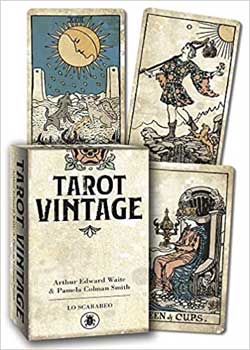
The classic Rider-Waite-Smith imagery printed with a linen finish and an aged, worn-in look, for readers who want an old-deck feel from the first shuffle.
Quick Uses
- Everyday reading: Use it as your working deck for daily and client readings.
- Ancestor reading: Read with it when asking questions of the family dead; the aged look suits that kind of work.
- Altar image: Prop a card against a candle as the image for a spell.
- Study: Learn the RWS pictorial key on a deck that already feels handled.
How to Use It
Witchcraft & Folk Magick
- Lay a card beneath a candle in folk spells, choosing it for its meaning: the Sun for success, the Ten of Pentacles for the home.
- Read at the kitchen table, the way cards were read in many households for generations.
Ceremonial & Occult Magick
- Use the Majors’ astrological and Hebrew letter attributions from the Golden Dawn system in ritual timing.
- Meditate on one Major per week, working through the sequence in order.
Demonology & Black Magick
- Read before an evocation for timing and readiness, and after for the result.
- Ask an ancestor or familiar spirit to answer through the deck once an offering has been set out.
- Use the Devil or the Tower as the focal card of a curse or a binding.
A Simple Working
- Set a photo or keepsake of an ancestor on a cloth.
- Light a white candle and a stick of frankincense.
- Pour a small glass of water or the drink they liked.
- Shuffle and ask your question aloud, addressing them by name.
- Draw three cards and read them as their answer.
- Thank them and leave the drink out overnight.
- Pour the drink outside in the morning.
Pairs Well With
- Frankincense, for clearing the deck and the space.
- White candles, for ancestor readings.
- A tarot cloth, for a clean surface.
- A Marseille deck, for comparing an even older pattern.
What You Receive
A 2.85″ x 5″ box with 78 linen-finish tarot cards with an antiqued look, and instructions.
Origin & Lore
Tarot became a divination tool in late 18th-century France, and the 1909 Waite-Smith deck gave the English-speaking world its standard pictorial version. This edition keeps that pictorial key but gives the cards an aged background and selective colour.
Many readers prefer a deck that looks well used, and old cartomancy lore held that a deck grows more responsive the longer it is handled by one reader.
Did You Know?
The “Rider” in Rider-Waite-Smith is William Rider & Son, the London publisher that issued the deck in 1909.
| Weight | 0.8 lbs |
|---|
Related products


Altar Supplies