
Teardrop Stone Chakra Pendulum (Assorted)
$8.75
A Stone Chosen For You
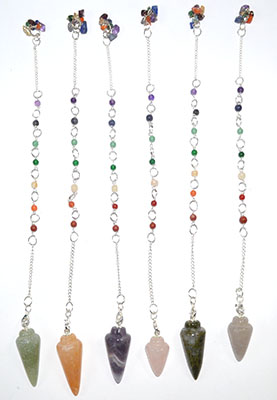
A polished teardrop pendulum on a seven-stone chakra chain, each one picked at random, for practitioners who like to let the stone find them.
Quick Uses
- Chakra Work: Use the seven stones on the chain as a guide when dowsing along the body.
- Discovery: Dowse with your new stone to ask what work it most wants to do.
- Detach: Unclip the lobster claw clasp to use the stone on its own.
- Daily Question: Ask one short question each morning and log the answer.
How to Use It
Witchcraft & Folk Magick
- Use it to choose which herb, oil or candle colour a spell needs.
- Keep it with your healing supplies for spiritual recovery work.
Ceremonial & Occult Magick
- Dowse over a table of stone correspondences to learn your new stone’s best use.
- Use the chain’s seven stones as a mnemonic when working with the planets.
Demonology & Black Magick
- Ask over a seal whether a spirit welcomes the stone you have been given as part of your altar.
- Read before and after evocation for yes or no confirmation.
- Record your stone type and answers in your grimoire.
A Simple Working
- Work with a white chime candle and a little frankincense.
- Look up the stone you received and note its traditional use.
- Pass the pendulum through the frankincense smoke.
- Say aloud the purpose you are giving it.
- Ask for yes and no swings, then ask whether the purpose suits the stone.
- Record the answer and keep the pendulum on your altar.
Pairs Well With
- White chime candles – a neutral light for dedication.
- Frankincense – a classic blessing smoke for new tools.
- A crystal reference book – to learn the stone you received.
- A pendulum chart – for answers beyond yes and no.
What You Receive
One polished teardrop stone pendulum, stone type chosen at random, on a removable seven-stone chakra chain of amethyst, iolite, blue aventurine, dark green aventurine, yellow aventurine, carnelian and red jasper, with a lobster claw clasp. Stone and chain sizes vary slightly. Sold individually.
Origin & Lore
The pendulum began as a dowser’s and diviner’s tool: a weight on a thread, a ring on a hair or a stone on a cord, held still until it swung to answer a question, find water or ore, or point to a hidden thing.
The seven-chakra chain draws on the yogic system of energy centres along the spine, which reached Western occultism in the early twentieth century and is now a common part of pendulum work.
Did You Know?
The rainbow colour scheme for the seven chakras is a modern Western addition; the Sanskrit text Sat-Chakra-Nirupana, translated by Sir John Woodroffe in The Serpent Power (1919), describes them by petals and seed syllables instead.
| Weight | 0.07 lbs |
|---|
Related products