Third Eye oil
Price range: $3.25 through $80.25
For opening the inner eye · Available in 3 sizes
An oil for anointing the brow to open the inner eye, worked for psychic sight, divination, meditation and dreamwork.
Quick Uses
- Divination: touch a drop between the brows before tarot, scrying or pendulum work.
- Meditation: dress a purple candle and meditate on its flame before divination.
- Tools: anoint a crystal ball, black mirror or the back of a tarot deck.
- Pathworking: anoint the brow before visualisation, pathworking or astral projection.
How to Use It
Witchcraft & Folk Magick
- Touch a drop between the brows before tarot, scrying or pendulum work.
- Dress a purple candle with the oil and meditate on its flame to quiet the mind before divination.
- Anoint a crystal ball, black mirror or the back of a tarot deck.
Ceremonial & Occult Magick
- Anoint the brow before visualisation, pathworking or astral projection.
- Dress the candles of the temple before scrying a spirit or a sigil.
A Simple Working
- Sit in a dark, quiet room with a purple chime candle and the oil.
- Dress the candle and light it.
- Place one drop of the oil on your fingertip and touch it between your brows.
- Gaze at the flame for a few minutes, then close your eyes and hold its image.
- Ask a single question and wait for an image or word to rise.
- Write down what you saw before putting out the candle.
Pairs Well With
- A purple chime candle: the classic colour for psychic work.
- Mugwort: for scrying and dreams.
- A black scrying mirror: to anoint and gaze into.
- Tarot cards: for divination after anointing.
What You Receive
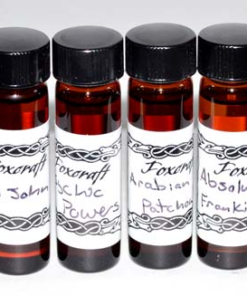
Third Eye oil, available in 2 dram, 1 oz and 16 oz.
Origin & Lore
The third eye comes from Hindu yoga, where the ajna chakra sits between the brows and is the centre of insight and command. The bindi and tilak worn on the forehead mark the same point. In Western occultism the idea was taken up in the nineteenth century, especially by Theosophy. This oil is a modern blend made for anointing that point.
René Descartes believed the pineal gland, a tiny organ deep in the brain, was where the soul meets the body, and later occultists made it the seat of the third eye.
Helena Blavatsky’s “The Secret Doctrine” (1888) linked the pineal gland to an ancient third eye that humanity had lost. In 1956 a book called “The Third Eye”, supposedly by a Tibetan lama named Lobsang Rampa, described surgery to open it and became a bestseller, though the author turned out to be a plumber’s son from Devon named Cyril Hoskin.
Did You Know?
Some lizards, including the tuatara of New Zealand, have a light-sensitive “parietal eye” on top of the head, connected to the pineal gland.
| Weight | N/A |
|---|---|
| Size | 2 dram, 1 oz, 16 oz |
Related products