Tiger Eye Rune Set
$30.75
Golden Runes For Bold Questions
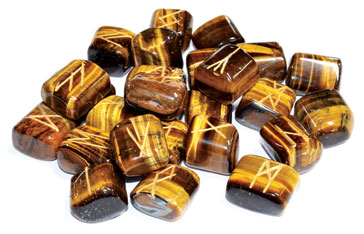
The 24 runes of the Elder Futhark plus a blank stone in tiger eye with gold lettering, chosen by casters who want a stone of courage and clear sight in their lots.
Quick Uses
- Casting: Cast three runes for a direct reading on a choice or challenge.
- Courage: Carry Uruz or Tiwaz before something that needs nerve.
- Career: Draw a rune before an interview or a big decision at work.
- Protection: Carry Algiz as a pocket ward.
How to Use It
Witchcraft & Folk Magick
- Carry a tiger eye rune as a charm for courage or protection.
- Lay Sowilo under a gold candle for success.
Ceremonial & Occult Magick
- Cast in the hours of the Sun for questions of success and standing.
- Set runes around a solar talisman to strengthen it.
Demonology & Black Magick
- Cast before and after an evocation to read the ground the working stands on and what it has stirred.
- Ask a called spirit to guide your hand into the bag, then read the runes it draws as its answer.
- Lay a single rune such as Thurisaz or Hagalaz on a seal or petition as the focal image of a hex or binding.
A Simple Working
- Light a gold or yellow chime candle and a little frankincense.
- State the challenge you face in one clear sentence.
- Draw three runes and lay them before the candle.
- Read them as the obstacle, your strength, and the way through.
- Keep the middle rune with you for the coming week.
- Let the candle burn down and return the other two runes to the pouch.
Pairs Well With
- Gold or yellow chime candles: for solar success and courage work.
- Frankincense resin: the classic solar incense.
- A rune cloth: a defined field for casting.
- A rune reference book: for deeper study of each stave.
What You Receive
One set of tiger eye rune stones with gold lettering: the 24 runes of the Elder Futhark plus one blank stone, in a pouch (pouch colour varies). Stones range from about 1/2″ to 1″ with varying widths; as natural stones, each piece varies in colour and pattern.
Origin & Lore
Runes were the alphabet of the early Germanic peoples, carved on stones, weapons and jewellery, and casting marked lots to read fate was an old Germanic practice that modern rune divination draws upon.
Tiger eye was carried in older European and Middle Eastern lore as a stone against the evil eye, its shifting band of light taken for a watchful eye.
Did You Know?
When Scandinavians simplified the runes in the Viking Age, the 24-rune Elder Futhark was cut down to the 16-rune Younger Futhark, used from around the 9th century.
| Weight | 0.6 lbs |
|---|
Related products