



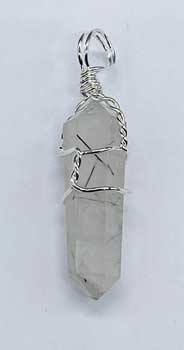
Tourmalinated Quartz Wire-Wrapped Point Pendants (Set of 5)
$21.95
Light and Shield in One Stone
Five wire-wrapped points of quartz threaded with black tourmaline, a combination practitioners wear daily for spiritual growth, letting go of the past and protection from negativity.
Quick Uses
- Daily Shield: Wear one every day as a protective pendant.
- Release: Wear one during work to let go of old patterns.
- Uncrossing: Carry one after a cleansing bath to keep negativity off.
- Home Wards: Hang them at the doors and windows of the home.
How to Use It
Witchcraft & Folk Magick
- Wear one during a waning moon cycle to let go of the past.
- Hang one over the front door as a ward that both clears and protects.
Hoodoo & Rootwork
- Wear one after an uncrossing bath to keep crossed conditions from returning.
- Dress one with Uncrossing oil and keep it in a white bag with hyssop.
- Set one in a saucer of salt in a room that has felt heavy, and replace the salt each week.
Ceremonial & Occult Magick
- Wear one through banishing rituals as a personal shield.
- Use one as a focus during meditation on spiritual growth.
Demonology & Black Magick
- Wear one as a protective pendant during evocation and banishing.
- Use one to absorb residual energy after spirit contact, then cleanse it in salt.
A Simple Working
- During the waning moon, light a black and a white chime candle side by side.
- Write what you want to let go of on a slip of paper.
- Hold a tourmalinated quartz pendant between the candles.
- Read the paper aloud and burn it in a heatproof dish.
- Let both candles burn down.
- Scatter the ash outside and wear the pendant from the next morning.
Pairs Well With
- Hyssop: A classic purifying herb for uncrossing.
- Black Tourmaline: For stronger protective work.
- Selenite: For clearing the pendants between wearings.
- Sea Salt: For simple cleansing baths and rings.
What You Receive
A set of five quartz with black tourmaline points, each wire wrapped as a pendant, approximately 1 3/8″ long. Sizes will vary. No chain or cord is included.
Origin & Lore
Tourmalinated quartz forms when black tourmaline needles grow inside quartz. It brings together two traditions: quartz as a clarifying, amplifying stone, and black tourmaline as a protector against negativity.
Tourmaline’s name comes from the Sinhalese turmali, used in Sri Lanka for mixed gemstones. Dutch traders found that heated tourmaline attracted ash, and black tourmaline is known to mineralogists as schorl.
Did You Know?
Black tourmaline is called schorl by mineralogists, and heated tourmaline was once used by Dutch traders to pull ash from pipes.
Related products


