


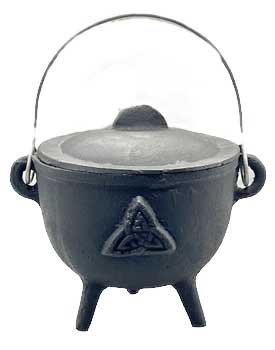

Triquetra cast iron cauldron, 4 1/2″
$28.55
A compact cauldron of the threefold knot
A small lidded cast iron cauldron marked with the triquetra, a compact vessel for burning herbs, resins and petitions on a working altar.
Quick Uses
- Herb burning: add sand and a charcoal disc, then burn rosemary, bay or juniper for protection.
- Threefold petition: write a wish three times, fold it three times and burn it inside on three nights running.
- Spell storage: keep a working’s ash or salt sealed under the lid until you dispose of it.
- Name-papers: burn an oil-dressed name-paper inside and add the ash to a mojo bag.
How to Use It
Witchcraft & Folk Magick
- Herb burning: a layer of sand and a charcoal disc turn it into a burner for protection herbs such as rosemary, bay or juniper.
- Threefold petition: write a wish three times on one strip of paper, fold it three times and burn it inside on three consecutive nights.
- Spell storage: with the lid on, it keeps a working’s ash or salt sealed until you are ready to dispose of it.
Hoodoo & Rootwork
- Burning name-papers: a name-paper dressed with oil is burned inside and the ash added to a mojo bag or sprinkled across a doorway.
A Simple Working
- Put a layer of sand in the cauldron and set a charcoal disc on top.
- Light the charcoal and wait until it glows evenly.
- Add a pinch each of bay leaf, rosemary and frankincense.
- Trace the triquetra in the air over the smoke with your finger, three times.
- Say: ‘Bound three times, guarded three times, blessed three times.’
- Carry the smoke to each doorway of the room.
- Close the lid to snuff the charcoal and bury the cold ash outdoors.
Pairs Well With
- Charcoal discs: the usual fire source for burning inside a cauldron.
- Frankincense resin: for consecration and blessing smoke.
- Bay leaves: to write on and burn for wishes.
- A cast iron chime candle holder: a matching iron piece for the same altar.
What You Receive
Cast iron cauldron with a triquetra on the front and a lid, about 4 1/2″ tall with lid and about 4″ across the mouth. Each is cast individually, so size and shape vary slightly and small imperfections in the iron are normal.
Origin & Lore
Small iron cauldrons descend from the hearth pots of household kitchens, scaled down for altar use. In modern witchcraft the cauldron holds fire for burning herbs and paper and water for brewing and scrying. The triquetra appears in early medieval Insular art and was used in Christian contexts for the Trinity; modern pagans read it as maiden, mother and crone, or land, sea and sky.
Three interlaced arcs and no beginning or end: the triquetra on the front of this little pot is one of the most recognised knots in Western symbolism.
The triquetra appears in the Book of Kells, made around 800, and is carved on early Christian stones in Ireland and on Norse-period metalwork. Its wide modern popularity among witches owes a good deal to the television series Charmed, whose Book of Shadows bore the symbol on its cover.
Did You Know?
The word triquetra comes from Latin and means ‘three-cornered’; it was originally used for any three-pointed shape, including triangles.
| Weight | 2.5 lbs |
|---|
Related products


