



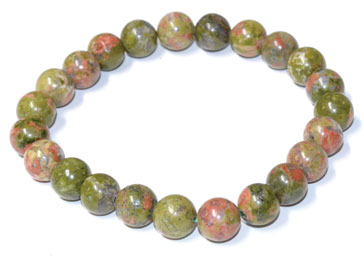
Unakite Bead Bracelet (8mm)
$5.45
For Settling Old Conflict
A bracelet of 8mm unakite beads, the pink and green stone practitioners reach for when they want quarrels settled and the mind brought back to the present.
Quick Uses
- Peacemaking: Wear it into a meeting or family visit where tempers tend to flare.
- Present Focus: Press a bead and name three things you can see whenever your mind runs ahead.
- Self-Worth: Wear it on the hand you write with when journaling about your own value.
- Fertility Altar: Lay it beside a green candle during workings for fertility and new life.
How to Use It
Witchcraft & Folk Magick
- Leave it on a windowsill in the green of spring sunshine, then wear it during fertility and garden workings.
- Tie it to the foot of a family photo on the altar during a working for household peace.
Hoodoo & Rootwork
- Keep it in a bowl with a little brown sugar and lavender to sweeten a tense household, wearing it when you go out.
- Wear it with a peace oil dabbed on the wrist when meeting someone you are trying to reconcile with.
Ceremonial & Occult Magick
- Wear it during workings of Venus aimed at concord between people rather than romance.
- Use it as a focus for a short daily meditation on releasing constriction and returning to balance.
Demonology & Black Magick
- Wear it when ending a working relationship with a spirit, as a token that the parting is made in peace.
- Offer it on the altar as a gift when asking a spirit to calm a dispute in your life.
A Simple Working
- Set a white candle on a heatproof dish in the room where the conflict happens.
- Sprinkle a pinch of dried lavender around it.
- Hold the bracelet and name the quarrel you want to see laid down.
- Light the candle and place the bracelet beside it.
- Let the candle burn for an hour while you speak calmly in the room.
- Snuff the candle and wear the bracelet the next time you see the other person.
Pairs Well With
- Lavender: A traditional herb for peace and calm in the home.
- White Candles: Neutral, peaceful lights for harmony workings.
- Rose Quartz: Adds a softer heart note to reconciliation.
- Peace Oil: For anointing the wrist before tense meetings.
What You Receive
One beaded bracelet of 8mm unakite beads.
Origin & Lore
Unakite is a modern stone in occult use, worked for balance, for the joining of heart and mind, and for patience in mending relationships. Its two colours are often read as the union of love and growth, which is why it turns up in fertility and family work.
It is an altered granite made of pink orthoclase feldspar, green epidote and clear quartz. It was named for the Unaka Mountains along the border of North Carolina and Tennessee, where it was first described.
Did You Know?
Unakite was first described from the Unaka Mountains of the southern Appalachians, which gave the stone its name.
Related products


