



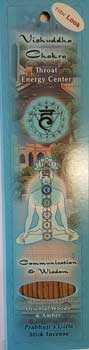
Vishuddha Chakra Incense Sticks (10 Pack)
$5.45
Clear Voice, True Expression
A hand-rolled incense of oriental woods and amber made for the Vishuddha, the throat chakra of ether, burned to support clear communication and self-expression.
Quick Uses
- Before Speaking: Burn a stick before a presentation, audition or difficult talk.
- Writing Ritual: Light one when you sit down to write something honest.
- Chanting: Burn a stick during mantra or vocal practice.
How to Use It
Witchcraft & Folk Magick
- Burn it with a blue candle during a spell to speak up for yourself.
- Light a stick while writing petitions so your words come clearly.
- Use it before channelling or automatic writing to open the voice of intuition.
Hoodoo & Rootwork
- Burn it while working a court case candle so your testimony is heard and believed.
- Smoke a written statement or letter with it before you deliver it.
Ceremonial & Occult Magick
- Use it during chakra work on Vishuddha while intoning its seed syllable HAM.
- Burn it before vibrating divine names or long invocations to settle the breath and voice.
Demonology & Black Magick
- Burn a stick before evocation so the conjuration is spoken clearly and with authority.
- Use it during spirit communication to keep exchanges clear and well understood.
A Simple Working
- Write what you need to say, plainly, on a sheet of paper.
- Light a light blue candle and a Vishuddha stick.
- Rest two fingers lightly at the base of your throat and breathe slowly.
- Intone HAM several times, then read your words aloud once.
- Pass the paper through the smoke and fold it in half.
- Keep it with you on the day you speak, and burn it once you have said it.
Pairs Well With
- Blue Lace Agate: A throat chakra stone kept for gentle, clear speech.
- Light Blue Candles: For communication and truth workings.
- Svadhisthana Chakra Incense: Another centre in the same hand-rolled series.
- Lapis Lazuli: A stone of truth and wisdom often paired with throat work.
What You Receive
One pack of 10 hand-rolled Vishuddha Chakra incense sticks, a blend of oriental woods and amber.
Origin & Lore
Vishuddha is the fifth chakra in the Hindu tantric system, placed at the throat and linked with ether or space, akasha. It is associated with communication, self-expression and, at its height, the inner communion of meditation.
Woods and amber make a fitting smoke for this centre: dry, clear and resinous rather than sweet, suited to focus and speech.
Did You Know?
Vishuddha means especially pure in Sanskrit, and it is pictured as a sixteen-petalled lotus, the petals often linked to the sixteen Sanskrit vowels.
Related products


