



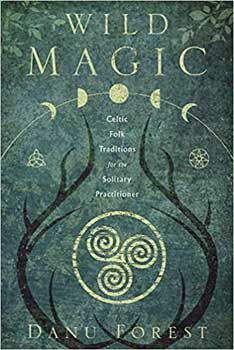

Wild Magic by Danu Forest
$19.79
Celtic Faerie Faith Magick
A guide to the animist Celtic faerie faith: working with faerie folk, green kin, ancestors and spirits of the land, plus elemental magick and herbal craft.
Quick Uses
- Land Spirits: Leave a small offering at the same tree or stone each week and note what you notice.
- Fire Scrying: Try fire scrying at a hearth or outdoor fire.
- Herbal Craft: Make one of the oils, salves or bundles with herbs you can gather.
How to Use It
Witchcraft & Folk Magick
- Leave milk, honey or bread at a hawthorn or old stone for the good folk.
- Wildcraft common herbs on a dry morning and make a small bundle for protection.
Ceremonial & Occult Magick
- Walk a local old track or boundary and sit where paths meet to listen.
- Use fire scrying at dusk and record images in a journal.
Demonology & Black Magick
- Call on your spirit allies for protection before working in wild or haunted places.
- Honour the ancestors of the land before any spirit work outdoors.
A Simple Working
- At dusk, light a small outdoor fire or a candle in a lantern.
- Pour a little milk on the ground for the spirits of the place.
- Sit and soften your eyes on the flames.
- Ask one clear question.
- Watch for shapes and images in the fire.
- Write them down and leave a final offering when you go.
Pairs Well With
- Mugwort: A traditional Celtic seeing herb.
- Beeswax Candles: Natural light for offerings.
- Hawthorn Berries: Long tied to faerie lore.
- Mortar & Pestle: For herbal salves and oils.
What You Receive
One copy of Wild Magic by Danu Forest. A 6″ x 8.9″ paperback with 240 pages.
Origin & Lore
This book explores the animist practices of the Celtic faerie faith: forming bonds with the good folk, plant spirits, the ancestors and the spirits of place. It covers calling on spirit allies for protection, elemental techniques such as fire scrying and raising the wind, ley lines, faery roads and spirit paths, and recipes for oils, salves, bundles and ointments.
Belief in the good folk ran deep across Ireland, Scotland, Wales, Cornwall and Brittany. W. Y. Evans-Wentz recorded it in The Fairy-Faith in Celtic Countries in 1911, and hawthorns and old raths were left untouched for fear of offending their residents.
Did You Know?
The term ley line was coined by Alfred Watkins in 1921, and he set out his theory in The Old Straight Track in 1925.
Related products


