


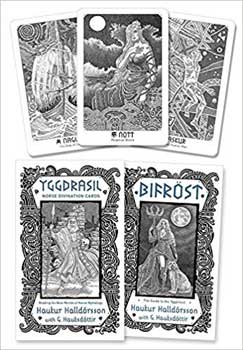
Yggdrasil Norse Divination Cards by Halldorsson & Hauksdottir
$35.19
The Eddas In 81 Cards
An 81-card Norse divination deck in fine pen and ink, drawn from the Eddas by an artist active in the heathen revival, for readers who work with the Nordic gods.
Quick Uses
- Daily rune of the Eddas: Pull one card and read the myth behind it before your morning offering.
- God reading: Ask which deity of the Norse pantheon to approach for a matter.
- Nine-card spread: Lay nine cards for the nine worlds when you need a full picture.
- Blót companion: Read at a blót to hear what the gods ask in return.
How to Use It
Witchcraft & Folk Magick
- Draw before a seasonal offering and set the card on the altar beside the mead or bread.
- Use the cards alongside runes to give you mythic stories as well as staves.
Ceremonial & Occult Magick
- Meditate on one card each night to learn the Eddic myths in order.
- Read before seiðr or trance work to choose the world and helper you will seek.
Demonology & Black Magick
- Ask the dead of your line to answer through the deck after an offering at the grave or ancestor shelf.
- Read before and after a working with a fierce spirit, giant or wight, and log the change.
- Lay a card of a wrathful figure as the focal image of a nīð or cursing working.
A Simple Working
- Pour a small horn or glass of mead and set it on your altar.
- Light a candle and a pinch of juniper or mugwort.
- Call on Odin as the one who won the runes, and ask your question.
- Lay three cards: the Norn of what was, of what is, and of what shall be.
- Read the guidebook’s entries and sit with the myth each card draws on.
- Leave the mead overnight, then pour it outside as an offering.
Pairs Well With
- Elder Futhark runes: Pair Eddic images with the 24 staves.
- Mead or ale: The traditional offering for the Norse gods.
- Juniper: Burned for cleansing in Scandinavian folk practice.
- Altar cloth: A dedicated surface for reading with the gods.
What You Receive
One boxed kit: an 81-card deck with pen-and-ink artwork and a 216-page guidebook.
Origin & Lore
Norse divination began with lot-casting: marked slips or staves thrown and read, as Tacitus described among the Germanic tribes. Card decks like this one carry that habit of reading signs into a modern form, built on the myths of the Eddas.
The Poetic and Prose Eddas, written down in Iceland in the thirteenth century, preserve most of what survives of Norse mythology, and these cards illustrate their stories.
Did You Know?
In the Hávamál, Odin hangs on the windswept tree for nine nights, wounded by a spear, before he takes up the runes.
| Weight | 1.6 lbs |
|---|
Related products


Crystal Balls