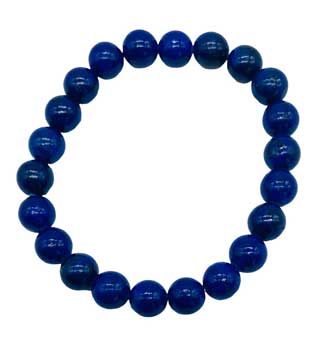
Lapis Lazuli Bead Bracelet (8mm)
$14.25
Royal Blue of the Third Eye
A bracelet of 8mm lapis lazuli beads, an ancient stone of the third eye worn for self-awareness, self-expression and revealing inner truth.
Quick Uses
- Third Eye: Touch a bead to your brow before meditation or divination.
- Speak Up: Wear it when you need to express yourself honestly.
- Inner Truth: Hold it while journaling to reach what lies beneath the surface.
- Study: Wear it when studying sacred or occult texts.
How to Use It
Witchcraft & Folk Magick
- Wear it during tarot and rune readings to sharpen insight.
- Lay it on your brow during a full moon meditation for inner vision.
- Keep it with your Book of Shadows to honour the wisdom recorded there.
Hoodoo & Rootwork
- Carry it with a piece of Little John root to court for clear testimony and truthful dealings.
- Keep it on a petition paper asking for hidden truths to come out.
Ceremonial & Occult Magick
- Wear it in Jupiterian workings for wisdom and rightful authority.
- Use it during pathworking and inner journeys as a stone of the heavens.
- Wear it during study of astrology, as lapis has long been tied to the starry heavens.
Demonology & Black Magick
- Wear it when consulting spirits for hidden knowledge, as a token of truthful answers.
- Use it in ancestor work to honour old royal and priestly traditions of the stone.
A Simple Working
- Sit before a dark blue candle in a quiet room.
- Hold the bracelet and touch one bead to your brow.
- Ask one question about yourself that you have avoided.
- Close your eyes and wait, letting images and words come without judging them.
- Write everything down, then put the bracelet on.
- Repeat for three nights and compare what you wrote.
Pairs Well With
- Dark Blue Candles: For wisdom, truth and psychic work.
- Little John Root: A traditional hoodoo root for court cases.
- Sodalite Tumbled Stone: A related blue stone for truth and insight.
- Frankincense Incense: A classic temple scent for sacred study.
What You Receive
One stretch bracelet of 8mm lapis lazuli beads.
Origin & Lore
Lapis lazuli is one of the oldest sacred stones: it was mined in the Badakhshan region of Afghanistan for thousands of years and traded across the ancient world. It is traditionally worked for wisdom, truth and spiritual vision.
Ancient Egyptians used lapis for amulets and inlays, including on the funerary mask of Tutankhamun, and in Mesopotamia it adorned the jewellery found in the royal tombs of Ur. Ground into powder, it became the costly blue pigment ultramarine used by medieval and Renaissance painters. In medieval Europe lapis was associated with the heavens and with royalty, and painters reserved ultramarine for the robes of the most honoured figures.
Did You Know?
The pigment ultramarine, made from lapis, takes its name from Latin ultramarinus, meaning beyond the sea.
Related products