


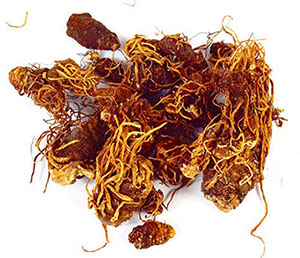


John the Conqueror is a folk hero of African American lore, and three roots carry his name: High John to win, Little John to talk your way through, and Low John to hold your ground.
Origin & Traditional Use
Low John is the dried rhizome of trillium, a woodland wildflower of eastern North America with three leaves and three petals. Known as birthroot and beth root, it was traditionally used in women’s remedies.
In hoodoo it joined High John (Ipomoea jalapa) and Little or Chewing John (galangal) as one of the three Johns.
Uses by Tradition
Hoodoo & Rootwork
- Court cases: carry Low John in your pocket in court, often in the same bag as High John and galangal for all three Johns’ strength.
- Family matters: keep the root in the home for the protection and steadiness of a marriage and household.
- Feeding: dress the root with a drop of whiskey or a conquering oil to keep it working.
A Simple Working
- Gather a Low John root, a piece of galangal root, a small square of paper and a red flannel bag.
- Write your name and the word victory on the paper, with the case number or the matter at hand.
- Fold the paper toward you around the Low John root.
- Put it in the bag with the galangal, breathe into the bag and state what you will win.
- Feed the bag a drop of whiskey and close it.
- Carry it on you to court or the meeting.
Pairs Well With
- High John the Conqueror root: for power and mastery.
- Galangal: Little John, chewed or carried for court.
- Deer’s tongue: a hoodoo herb for persuasive speech in court.
- Calendula: worked for respect and favour in legal matters.
- Red flannel bag: the traditional mojo bag.
Lore & History
In the folk tales, John the Conqueror was an African prince sold into slavery who never broke, outwitting his masters with laughter and cunning. A Harlem Renaissance writer set the tales down in a celebrated 1943 essay.
His roots carry that unbroken spirit into the work.
What You Receive
Whole dried Low John root, available in 1 oz, 2 oz and 1 lb.
Did You Know?
Trillium seeds carry small fatty appendages that attract ants, which carry the seeds off to their nests and so plant the next generation.
| Weight | N/A |
|---|---|
| Size | 1 oz, 2 oz, 1 lb |
Related products


