


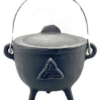

Tree of Life cast iron cauldron
Price range: $35.15 through $104.45
A cauldron of roots and rebirth · Available in 2 sizes
A lidded three-legged cast iron cauldron with a raised Tree of Life, the vessel of burning and transformation tied to roots, ancestry and growth.
Quick Uses
- Burning bowl: burn herbs or resin on charcoal over sand inside, then lid it to smother the fire when done.
- Petitions: burn what you want ended or begun and bury the cooled ash at the root of a tree.
- Ancestors: burn rosemary and a written list of your dead inside on Samhain or a family anniversary.
- Scrying: fill it with water and a little ink for a dark, still surface to gaze into by candlelight.
How to Use It
Witchcraft & Folk Magick
- Burning bowl: set a disc of charcoal on a bed of sand inside and burn loose herbs or resin; the lid smothers the fire when the rite is done.
- Petition burning: write what you want ended or begun, burn it inside, and carry the cooled ash to a crossroads or bury it at the root of a tree.
- Ancestor vessel: on Samhain or a family anniversary, burn rosemary and a written list of your dead inside it, with the tree side facing you.
Ceremonial & Occult Magick
- Seat of the element: placed in the west or at the centre of the circle as the vessel of Water and of rebirth.
- Scrying: filled with water and a little ink, the black interior gives a dark, still surface for gazing by candlelight.
A Simple Working
- Fill the cauldron a third full with sand and set it on a heatproof tile.
- Light a charcoal disc and lay it on the sand.
- Sprinkle on a pinch of rosemary and a pinch of mugwort.
- Name aloud three ancestors, or say ‘those who came before me’ if you do not know their names.
- Sit with the smoke and listen for as long as it rises.
- Close the lid to put out the charcoal, then scatter the cold ash beneath a tree.
Pairs Well With
- Charcoal discs: to burn resin and herbs inside the bowl.
- Sand: to bed the charcoal and spread the heat.
- Rosemary: the classic herb of remembrance for ancestor work.
- Parchment paper: for petitions burned in the cauldron.
What You Receive
Solid black cast iron cauldron with a raised Tree of Life on both sides, removable lid with a top handle, a swing handle attached at the side loops and three sturdy legs. Available in 5″ and 6″ sizes, both with lid. The larger cauldron stands just under 6″ tall with a 5″ mouth and a bowl about 5″ deep, measuring 6 1/2″ across the handle tabs.
Origin & Lore
The three-legged iron pot was the cooking vessel of ordinary households across Europe for centuries, built to stand in the embers of an open hearth. Because it held fire, food and medicine-making in one place, it passed easily into witchcraft as the vessel of transformation. The Tree of Life cast on its sides is an ancient motif linking the underworld, the living world and the heavens through root, trunk and crown.
Lift the lid and you are looking into the oldest working shape in the craft: a pot of black iron that stands on three legs so it can sit straight in the coals.
Welsh tradition tells of Ceridwen’s cauldron, which she kept boiling for a year and a day to brew wisdom for her son; three drops splashed onto the boy Gwion Bach, who became the poet Taliesin. In Irish myth the Dagda owned a cauldron from which no company ever went away unsatisfied. Shakespeare fixed the image of three witches around a pot in Macbeth with ‘Double, double toil and trouble’.
Did You Know?
The Gundestrup cauldron, a silver vessel decorated with gods and animals, was found by peat cutters in a Danish bog in 1891 and is often linked to Celtic religious imagery.
| Weight | N/A |
|---|---|
| Option | 5" with lid, 6" with lid |
Related products


