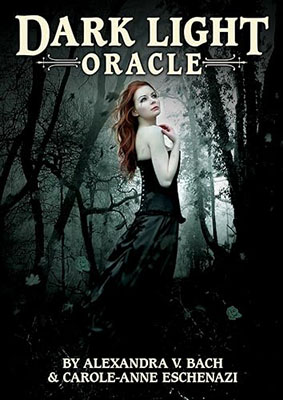
Dark Light Oracle by Bach & Eschenazi
$25.25
Shadow Work Oracle for the Crossroads
A 40-card oracle built around the meeting point of light and darkness, reached for when a reader wants honest messages about grief, fear and the growth that comes out of them.
Quick Uses
- Shadow draw: Pull one card at the dark moon and write down what it shows you about the part of yourself you keep hidden.
- Crossroads reading: Lay three cards for past, present and the road ahead when you stand between two choices.
- Altar focus: Prop the card you drew on your altar for the length of a working so its message stays in front of you.
- Healing check-in: Draw a card after a hard working or a loss to see what needs tending next.
How to Use It
Witchcraft & Folk Magick
- Read at the dark moon or on a Monday night for questions about the hidden self, old wounds and what you are ready to release.
- Keep one card under a bowl of salt water during a cleansing bath, then read it afterwards as the word of the waters.
Ceremonial & Occult Magick
- Draw before a working to name the shadow you are bringing into the circle, and again afterwards to see what shifted.
- Use the guides as a contemplation sequence, working one card a night across the full set of 40.
Demonology & Black Magick
- Read before an evocation to see what state you are in and whether the timing is right, and again once the spirit has been licensed to depart.
- Ask a spirit you already work with to answer through the deck, drawing slowly while you keep your attention on its seal.
- Lay a card face-up at the centre of a crossroads offering so the spirit of the place has an image to speak through.
A Simple Working
- Work at night with the room lit by a single black chime candle.
- Burn a pinch of mugwort on charcoal and pass the deck through the smoke three times.
- State aloud the one fear or sorrow you want to understand.
- Shuffle until the deck feels settled, then cut it into three piles with your left hand.
- Turn the top card of each pile: what you carry, what you are refusing to see, and what light comes from it.
- Sit with the three cards until the candle burns down, and write in your journal what comes to you.
- Return the cards to the deck and put the candle stub at a crossroads or bury it.
Pairs Well With
- Black chime candles: small enough to burn out during a single reading, and they set a shadow-work tone.
- Mugwort: the traditional herb for opening the inner eye before divination.
- A black obsidian scrying mirror: for going deeper into an image the cards have raised.
- A blank journal: to keep a record of draws and see the patterns that build up over months.
What You Receive
One oracle deck of 40 cards with a 76-page guidebook.
Origin & Lore
Oracle decks grew out of the old practice of seeking a divine or spirit answer through signs, and out of the illustrated fortune-telling cards that became popular in Europe in the late eighteenth and nineteenth centuries. Unlike tarot they follow no fixed structure, so each deck sets out its own system of meanings.
This deck takes the crossroads as its central image, the place where past and present experience meet. The crossroads has long been a site of spirit contact in European and African diaspora folk practice, and in Greek religion it belonged to Hecate, who received offerings there at the dark of the moon.
Did You Know?
The word oracle comes from the Latin oraculum, built on orare, meaning to speak or to pray: an oracle was first the answer given, not the cards or person giving it.
| Weight | 0.7 lbs |
|---|
Related products

Altar Supplies

Crystal Balls