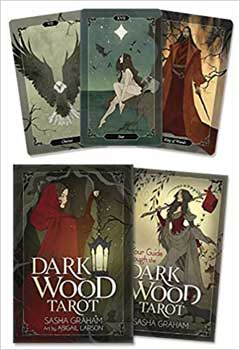
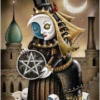

Dark Wood Tarot by Graham & Larson
$35.19
A Witch’s Tarot for Shadow Work
A Rider-Waite-Smith-style tarot in which the reader walks the dark wood as a witch, chosen by practitioners who want a deck that speaks plainly about desire, fear and hidden power.
Quick Uses
- Shadow spread: Lay out cards for what you desire, what you fear and what you hide, and read them as one picture.
- Dream work: Draw a card before sleep and place it under your pillow, then compare it with what you dream.
- Daily draw: Turn one card each morning and note how its vision plays out by nightfall.
- Ritual timing: Read before a working to decide whether to go ahead now or wait.
How to Use It
Witchcraft & Folk Magick
- Read in the wild or with a branch, stone or leaf from your local wood on the table to tie the reading to real land.
- Use the animal cups and natural-world pentacles as images for charm bags, choosing the card that matches what the charm is for.
Ceremonial & Occult Magick
- The suits keep their traditional elemental attributions, so the deck works with standard Golden Dawn correspondences for planetary and elemental rites.
- Use a Major Arcana card as the doorway for a path-working, visualising yourself stepping into the scene and walking deeper into the wood.
Demonology & Black Magick
- Draw before an evocation to see what you are carrying into the circle, and afterwards to read the outcome of the rite.
- Divine which spirit to approach for a matter by laying out a card for each candidate and reading which answers most clearly.
- Set a swords card as the focal image of a binding or hexing working, laid under the candle for the duration.
A Simple Working
- Set a black chime candle and a small dish of mugwort on your table.
- Light the candle and burn a pinch of the mugwort, letting the smoke pass over the deck.
- Separate out the Moon card and lay it at the top of your space as the gate into the wood.
- Shuffle the rest while asking what lies in your own shadow right now.
- Draw three cards beneath the Moon: what calls you in, what waits in the dark, and what you bring back out.
- Read them in order as one walk through the wood and write what you see.
- Let the candle burn out, then return the Moon card to the deck last.
Pairs Well With
- Mugwort: burned before reading for clearer sight and stronger dreams.
- Black chime candles: a simple way to mark the start and end of a shadow reading.
- A black velvet tarot bag: to keep the deck wrapped and apart from everyday things.
- A blank book of shadows: to record spreads and the visions each card brings.
What You Receive
One tarot deck of 78 cards with a 304-page guidebook, boxed. The set measures 5.7 x 0.4 x 8.4 inches.
Origin & Lore
Tarot began in fifteenth-century Italy as a card game played with an extra suit of trumps. It was only in the late eighteenth century that French occultists began using it for divination, and the modern reading tradition rests largely on the 1909 deck drawn by Pamela Colman Smith to A. E. Waite’s instructions.
This deck follows that Rider-Waite-Smith pattern but recasts the suits as visions met in the wood: legends for wands, fears for swords, animals for cups and the natural world for pentacles. The forest as a place of trial, witches and transformation is one of the oldest settings in European folk tale.
Did You Know?
Pamela Colman Smith was paid a flat fee for the 78 designs she drew in 1909 and received no royalties from the deck that became the most widely copied tarot in the world.
| Weight | 2.2 lbs |
|---|
Related products