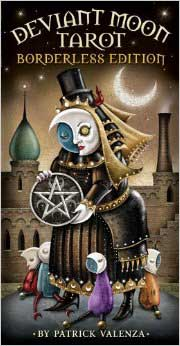
Deviant Moon Tarot (Borderless Edition) by Patrick Valenza
$24.14
Moonlit Tarot, Larger Borderless Cards
The borderless edition of the Deviant Moon Tarot, with larger cards that let Patrick Valenza’s strange moonlit figures fill the whole face, favoured by readers who work by image and intuition.
Quick Uses
- Night reading: Read by moonlight or candlelight, letting the dreamscape images lead rather than the book meanings.
- Dream incubation: Choose a card that matches the dream you want and set it by your bed before sleep.
- Graveyard work: Carry a single card as a focus when you visit a cemetery for spirit contact.
- Full-moon spread: Lay a monthly reading on the night of the full moon and review it at the next.
How to Use It
Witchcraft & Folk Magick
- Time readings to the phases of the moon, asking about beginnings at the new moon and about what has ripened at the full.
- Pick a card as a charm image and keep it on your altar beside a bowl of water under the moon.
Ceremonial & Occult Magick
- The traditional 78-card structure keeps all Golden Dawn correspondences, so the deck slots straight into planetary and lunar rites.
- Use the borderless images for path-working and scrying meditations, gazing into a card until the scene moves.
Demonology & Black Magick
- The deck’s graveyard imagery suits necromantic work: read before calling on the dead, and ask the spirit to answer through the cards.
- Lay a card as the focal image of a working on the altar, with the seal of the spirit you are petitioning beneath it.
- Read before and after an evocation to check the timing and the result.
A Simple Working
- On a night when the moon is visible, set a white or silver chime candle beside a glass of water.
- Burn a little mugwort and pass the deck through the smoke.
- Hold the deck to the moon or its reflection in the water and name your question.
- Shuffle and draw five cards in a cross: the centre is the matter, the others what lies above, below, behind and ahead.
- Read the images first, before you open the booklet, and write what each figure seems to be doing.
- Pour the water out onto the earth when you finish, and let the candle burn down.
Pairs Well With
- Mugwort: the classic lunar herb for dreams and second sight.
- A moonstone: kept with the deck to tie it to the Moon between readings.
- A black obsidian scrying mirror: for going further into an image that catches you.
- A tarot cloth: to give the larger cards a clean surface to lie on.
What You Receive
One borderless tarot deck of 78 cards with a 48-page instructional booklet. The card stack measures 5 1/8″ x 2 5/8″ x 1 1/8″.
Origin & Lore
Tarot was first played as a trick-taking game in Italian courts in the fifteenth century and became a tool of divination only in eighteenth-century France. The 22 trumps that later became the Major Arcana were the game’s special cards, including the Moon itself.
Patrick Valenza’s deck sets the traditional structure in a world of stylized figures and moonlit dreamscapes. This edition removes the card borders and enlarges the cards so more of his artwork shows.
Did You Know?
The Tarot de Marseille pattern was printed from carved woodblocks, with colour added afterwards through stencils, which is why old Marseille decks show bold outlines and only a handful of flat colours.
| Weight | 0.7 lbs |
|---|
Related products