
Golden Art Nouveau Tarot
$29.65
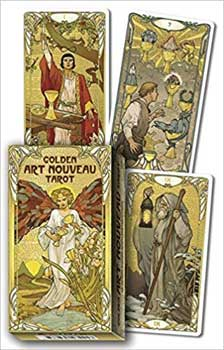
Gilded Art Nouveau Tarot
A gold-foiled tarot in the flowing lines of art nouveau, built on Rider-Waite-Smith symbolism and favoured by readers who want elegance at the table.
Quick Uses
- Client Readings: Use it as a presentation deck when reading for others; the traditional symbolism keeps meanings clear.
- Glamour Work: Set the Empress or the Star on your vanity while you dress for a glamour spell.
- Daily Card: Draw one card each morning and let its colours set the tone of your day.
- Meditation: Trace the curved lines of a single card with your eyes to slow the mind before a reading.
How to Use It
Witchcraft & Folk Magick
- Lay the Empress, the Lovers or the Star in a love or beauty spell beneath a pink or red candle.
- Keep a card on a Friday altar, the day of Venus, for ongoing attraction work.
Ceremonial & Occult Magick
- Use the RWS framework with its Golden Dawn correspondences to time readings to planetary days.
- Choose a trump as a meditation gate and work its symbolism through visualisation.
Demonology & Black Magick
- Read before approaching a spirit of love or lust to ask how the working will be received.
- Lay a chosen card under a black candle as the focal image of a binding or banishing working.
- Divine with a single card after an offering to see whether it was accepted.
A Simple Working
- On a Friday evening, light a pink chime candle anointed with a little rose oil.
- Shuffle while naming the person, quality or outcome you are working toward.
- Draw one card and place it face up before the candle as the image of your goal.
- Scatter a few dried rose petals around the card.
- Speak your intention three times while gazing at the card.
- Let the candle burn out, then keep the card on the altar for seven days before returning it to the deck.
Pairs Well With
- Rose petals: a classic Venusian herb for attraction and beauty workings.
- Pink chime candles: sized for a single short spell alongside the card.
- Rose quartz: traditionally kept with decks used for love readings.
- Altar cloth: a plain cloth lets the gold foil stand out.
What You Receive
One tarot deck of 78 cards with gold-foil details and an instructional booklet, in a 2 3/4″ x 4 3/4″ box.
Origin & Lore
Tarot cards were first made in fifteenth-century Italy for a trick-taking game and only later became a tool of divination, first in France from the 1780s and then through the occult societies of Victorian Britain.
Artist Giulia F. Massaglia brings the Rider-Waite-Smith symbolism into the art nouveau style, the ornamental movement of curving lines and natural forms that flourished around 1890 to 1910, the same years the RWS deck itself was created.
Did You Know?
The Rider-Waite-Smith deck was first published in London in December 1909 by William Rider & Son, which is how ‘Rider’ ended up in its name.
| Weight | 0.6 lbs |
|---|
Related products