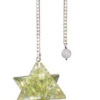
Apophyllite Pendulum
$10.95
Bright Stone For Spirit Contact
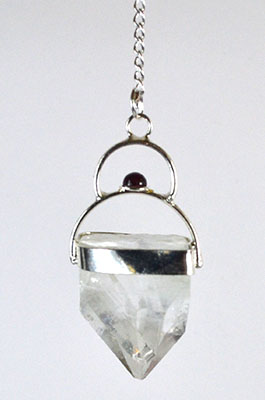
An apophyllite pendulum on a silver-toned chain, kept by readers who use it as a link between ordinary sight and the unseen.
Quick Uses
- Spirit Questions: Ask an ancestor or familiar spirit to answer through the swing during a quiet sitting.
- Meditation: Hold it still before your eyes and watch it as a focus point when going into trance.
- Dream Work: Ask a question at bedtime, then dowse over your dream notes in the morning for the meaningful image.
- Yes/No Work: Use it for direct questions once your yes and no swings are set.
How to Use It
Witchcraft & Folk Magick
- Use it at an ancestor altar to ask whether an offering has been accepted.
- Dowse over a list of dream images to find which one carries the message.
Ceremonial & Occult Magick
- Use it as a fixation point to still the mind before scrying or path-working.
- Dowse over a Tree of Life diagram to see which sphere a vision or question belongs to.
Demonology & Black Magick
- Inside a cast circle, invite a called spirit to move the pendulum, then put your questions in yes/no form.
- Dowse over a list of names or seals to divine which spirit to approach for a given work.
- Ask before and after an evocation whether the spirit is present, and whether it has departed.
A Simple Working
- Light a white candle and a little frankincense at your ancestor or spirit altar.
- Set a glass of water beside the candle as an offering.
- Hold the pendulum above the glass and speak the name of the spirit you wish to reach.
- Wait for the pendulum to begin moving on its own before asking anything.
- Ask simple yes/no questions and note each answer.
- Thank the spirit by name and say clearly that the sitting is ended.
- Pour the water out at the foot of a tree or at a crossroads.
Pairs Well With
- White chime candles: quiet light for spirit sittings.
- Mugwort: drunk as tea or burned to open dream and trance sight.
- A spirit board: for fuller spelled answers once contact is made.
- Selenite: a companion stone for cleansing the pendulum between sittings.
What You Receive
One apophyllite pendulum on a silver-toned chain. As a natural stone, each piece varies slightly.
Origin & Lore
Pendulums were first used as dowsing tools, to find water, ore and lost or buried things, before they took their place in question-and-answer divination over charts, letters and maps.
Apophyllite is a relatively recent stone in occult practice; it was named in the early 19th century and found its way into crystal work in the 20th.
Did You Know?
Apophyllite was named in 1806 by the French mineralogist René Just Haüy, from the Greek for “to flake off”, because the stone flakes apart when heated.
| Weight | 0.03 lbs |
|---|
Related products