Assorted Gemstone Pendulum
$5.45
A Stone Chosen For You
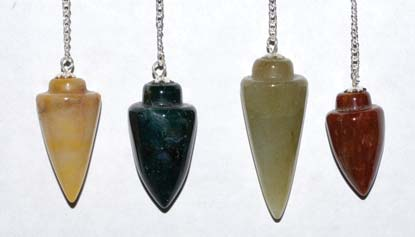
A gemstone pendulum drawn from a mixed batch, so the stone that arrives is the one that found its way to you, ready for yes/no work, dowsing and charm-testing.
Quick Uses
- Yes/No Questions: Hold the chain still over your palm, establish which swing means yes and which means no, then ask one clear question at a time.
- Choosing Supplies: Dangle it over two or three herbs, oils or candles and work with whichever one draws the strongest movement.
- Charting: Suspend it over a simple fan chart of options written on paper and let it settle toward an answer.
- Reading the Stone: Look up the stone you received and fold its traditional correspondences into how you use it.
How to Use It
Witchcraft & Folk Magick
- Dowse over a row of herbs or crystals before building a jar or sachet, keeping only what the pendulum confirms.
- Hold it over a written list of dates to choose the night for a working.
- Ask whether a charm bag or poppet is still active before you refresh or retire it.
Ceremonial & Occult Magick
- Swing it over a planetary or elemental chart to confirm which force governs a question.
- Use it to check that a circle or altar feels clear before you begin a rite.
Demonology & Black Magick
- Inside a cast space, after an invocation, ask a spirit to answer through the pendulum with the yes/no swings you agreed beforehand.
- Dowse over a sheet of seals or sigils to divine which spirit is willing to be approached for a particular matter.
- Check before and after an evocation whether the working has been heard and whether the space has been closed cleanly.
A Simple Working
- Light a white tealight and a stick of frankincense on a clear surface.
- Hold the pendulum in the smoke for a moment to clear it of other hands.
- Rest your elbow on the table and let the bob hang an inch above your open palm.
- Ask aloud, “Show me yes,” and watch the movement; then ask, “Show me no.”
- Note both movements in your journal so you can work with them consistently.
- Ask three simple questions you already know the answers to, to confirm the link.
- Thank the stone, wrap it in a small cloth and let the candle burn out.
Pairs Well With
- A pendulum mat or chart: gives the swing letters, numbers and answers to settle on.
- Frankincense resin: for smoke-cleansing the pendulum between sessions.
- A small velvet pouch: keeps the stone and chain together and away from other energies.
- A blank journal: for logging questions, swings and outcomes over time.
What You Receive
One gemstone pendulum. The stone is selected at random from an assortment that may include unakite, bloodstone, quartz, agate, moonstone and others; as natural stones, each piece varies in colour and pattern.
Origin & Lore
The pendulum’s oldest working use was finding things: water, ore, lost objects and buried goods. Dowsers held a weighted cord or rod and read its pull, and the same principle was carried into divination by suspending the bob over letters, maps or a hand.
In the 20th century French practitioners gave the art the name radiesthesia, and pendulum work over charts and samples became a standard tool of folk healers and diviners across Europe.
Did You Know?
In 1833 the French chemist Michel Eugène Chevreul published his experiments with a hand-held pendulum in a letter to André-Marie Ampère, one of the earliest scientific studies of how the pendulum moves.
| Weight | 0.04 lbs |
|---|
Related products


Altar Supplies