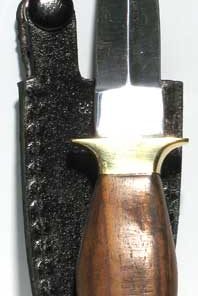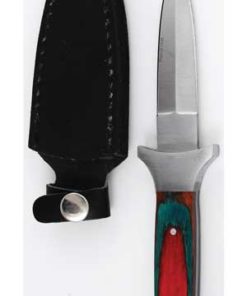

Bone Renaissance Athame
$35.15
A slender double-edged blade for directing will in the circle
The athame is the witch’s ritual knife, traditionally used to cast the circle, direct energy and command spirits rather than to cut anything physical.
Quick uses
- Casting: trace the circle’s edge with the blade.
- Directing: point it to send energy into a spell.
- Commanding: hold it before spirits as a sign of authority.
In stock
How to Use It
Witchcraft & Folk Magick
- Trace the circle clockwise with the point of the blade, seeing a line of light follow it.
- Lower the athame into the chalice in the symbolic Great Rite, uniting blade and cup.
Ceremonial & Occult Magick
- In ceremonial magick the blade belongs to the element of air or fire, and is used to draw pentagrams at the quarters.
- Its double edge and Renaissance lines suit formal rites drawn from the old grimoires.
Demonology & Black Magick
- The grimoires, from the Key of Solomon onward, call for a consecrated knife to draw the circle and hold spirits to their bounds.
- Practitioners point the athame at the triangle of art while issuing the charge to an evoked spirit.
- It is used to inscribe a spirit’s seal in the air or into candle wax before a working.
A Simple Working
- Cleanse the blade in incense smoke and pass it through a candle flame.
- Sprinkle it with salt water and breathe on it, naming it for each element.
- Hold it to the sky and dedicate it to your work.
- Use it to cast your first circle, walking clockwise from the east.
- Wrap it in dark cloth and keep it for ritual use only.
Pairs Well With
- Chalice: to pair with the blade on the altar.
- Altar pentacle: to complete the elemental tools.
- Consecration oil: to anoint the blade.
- Black cloth: to wrap and store it.
- Frankincense: for consecration smoke.
What You Receive
One Bone Renaissance athame with a slender double-edged blade and bone grip. Overall length 10″ with a 6″ blade.
Origin & Lore
The Key of Solomon, a grimoire of the Renaissance period, describes a black-hilted knife used to draw the circle and command spirits, a direct ancestor of the modern athame.
The word athame entered modern witchcraft through Gerald Gardner in the 1950s, possibly from the arthame of some versions of the Key of Solomon.
Did You Know?
In many traditions the athame is never used to cut anything physical; a separate white-handled knife, the boline, does the cutting of herbs and cords.
| Weight | 0.70 lbs |
|---|
You may also like…


Related products

All Herbs