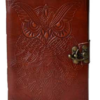
Broom & Pentagram Embossed Leather Journal with Latch
$20.85
The Witch’s Book of Secrets
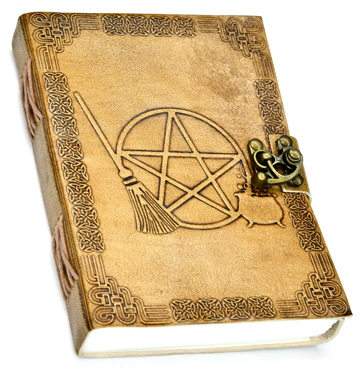
An aged-look leather journal with a pentacle, broom and cauldron framed in Celtic knotwork, made to be a witch’s Book of Shadows.
Quick Uses
- Book of Shadows: Write your rites, sabbats and correspondences into its 200 pages.
- Cauldron Recipes: Keep potion, brew and incense recipes with exact amounts.
- Cleansing Log: Record house sweepings and cleansings and when they were done.
- Spell Results: Note every working and come back later to write what happened.
How to Use It
Witchcraft & Folk Magick
- Keep it as a full Book of Shadows, with sections for sabbats, esbats, herbs, stones and spells.
- Record broom sweepings, floor washes and cleansings for the home.
Hoodoo & Rootwork
- Write down your floor wash and sweeping recipes with the ingredients used.
- Track candle work, noting how each candle burned and what followed.
Demonology & Black Magick
- Keep a private record of spirit work: seals, offerings of incense, candles or drink, and what came through.
- Design sigils on the pages and note when and how each was charged.
A Simple Working
- Sweep your working space with a broom, moving from the back of the room to the door.
- Light a black candle and a little frankincense.
- Place the journal in the centre of your altar and sprinkle a pinch of salt around it.
- Pass the book through the smoke and trace the pentacle on its cover with your finger.
- Open it and write a dedication stating that this is your Book of Shadows, private and protected.
- Close the latch, let the candle burn down safely and sweep the salt out of the door.
Pairs Well With
- A besom or altar broom, for clearing the space before you write.
- A small cast-iron cauldron, for the brews recorded in the book.
- Frankincense, for consecration.
- Sea salt, for a protective ring around the book on the altar.
What You Receive
One 5″ x 7″ aged-look leather journal with a latch closure. The front shows a pentacle, broom and cauldron, with Celtic knotwork framing the front and back. Contains 200 pages of tree-free recycled organic paper.
Origin & Lore
The Book of Shadows, a witch’s hand-copied book of rites and lore, was popularised by Gerald Gardner in the 1950s. In his tradition each initiate copied the coven’s book by hand, adding their own notes.
The broom, the cauldron and the pentacle are the oldest images of the witch in European art; the broom was used both for ritual sweeping and, in folklore, for flight.
Did You Know?
The earliest known picture of witches riding brooms is in a 1451 manuscript of Martin Le Franc’s poem Le Champion des Dames.
| Weight | 1 lbs |
|---|
Related products


All Journals