
Rune Compass Leather Blank Book with Latch
$21.95
A Norse Compass for Your Workings
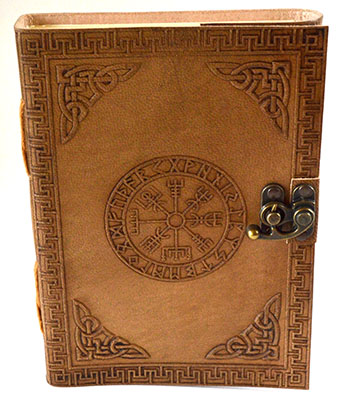
A leather journal embossed with a Viking compass of eight staves radiating from a centre, kept for rune study, divination records and protective work.
Quick Uses
- Rune Readings: Record each casting with the date, question and the runes drawn.
- Bindrunes: Design bindrunes on the unlined pages and note what each was made for.
- Rune Study: Give each of the 24 runes a page of meanings and your own notes.
- Travel Charm: Write a protective stave on the inside cover before a journey.
How to Use It
Witchcraft & Folk Magick
- Use it as a rune grimoire, with a page for each rune, its name, sound and meanings.
- Keep a casting log to learn the runes from your own readings.
Ceremonial & Occult Magick
- Record galdr chants and rune meditations, with the date and what was felt.
- Draw protective staves and note where you have marked them.
Demonology & Black Magick
- Ask a spirit questions through rune casting and write the runes and answers down.
- Design sigils and bindrunes and keep a record of how each was consecrated.
A Simple Working
- On a Wednesday, Odin’s day, light a white candle and a little juniper or mugwort.
- Draw the Vegvísir or your own compass stave on the inside cover.
- Hold your rune bag and ask what you most need to know this season.
- Draw three runes and lay them in a row.
- Write each rune, its name and your reading on the first page.
- Close the latch and keep the runes and the book together.
Pairs Well With
- A set of Elder Futhark runes, for the casting log.
- Juniper, a northern herb burned for cleansing and protection.
- A rune casting cloth, to read on.
- A fine black pen, for drawing staves and bindrunes.
What You Receive
One 5″ x 7″ leather journal embossed with a Viking-style compass of eight staves radiating from a central point, with a sturdy latch closure. Contains 240 pages of unlined paper.
Origin & Lore
Runes were first a writing system, used by Germanic peoples from about the 2nd century CE; their use for casting lots is suggested by Tacitus, who described the Germans marking slips of fruit-tree wood and reading them for counsel.
Icelandic magickal staves, the galdrastafir, were collected in manuscript grimoires of the early modern period and later, and the compass-like Vegvísir is one of the best known.
Did You Know?
The Vegvísir is recorded in the Huld Manuscript, compiled in Iceland in 1860, with the note that whoever carries it will not lose their way in storms or bad weather.
| Weight | 1 lbs |
|---|
Related products

All Journals


All Journals