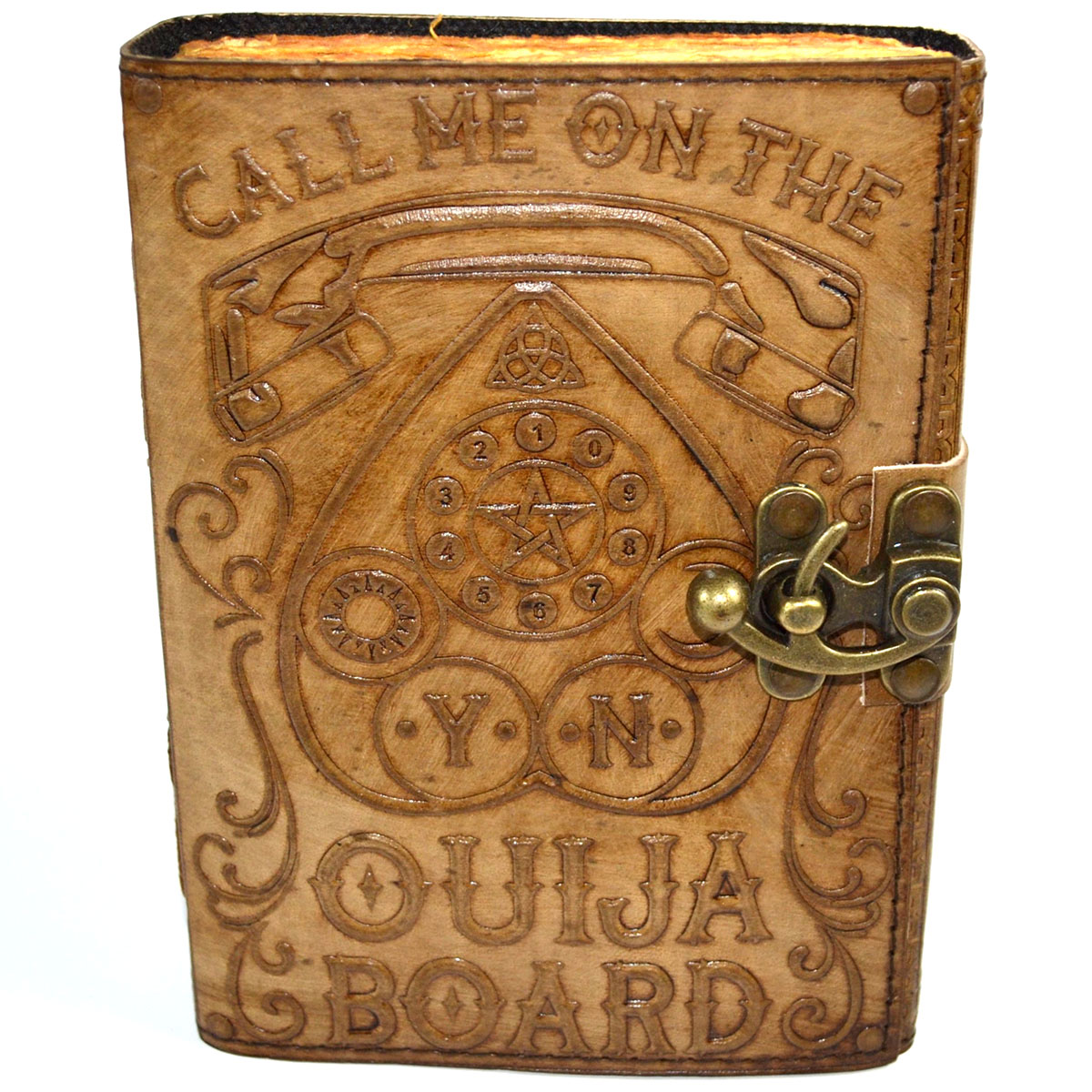
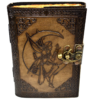
Call Me on the Ouija Board Leather Journal with Latch
$32.95
A Logbook for Spirit Board Sessions
A leather journal with a spirit board design on the cover, used to record board sessions, messages from the dead and other spirit work.
Quick Uses
- Session Log: Write the date, sitters, questions and every letter the planchette gives, in order.
- Spirit Names: Keep a list of the spirits who come through and how each presented.
- Ancestor Work: Record offerings and messages for your beloved dead.
- Cross-Checks: Note anything you can verify later and mark it when confirmed.
How to Use It
Witchcraft & Folk Magick
- Keep a full record of each spirit board session, spelling out messages letter by letter.
- Note candles, incense and offerings used at each sitting.
Ceremonial & Occult Magick
- Write opening and closing words for your board sessions and use the same ones every time.
- Record the planetary day and hour of sessions to see when contact is clearest.
Demonology & Black Magick
- Log spirit communication in detail: what was asked, what answered, the offerings made and how the session closed.
- Draw any seals or symbols a spirit gives, and keep them with the session notes.
- Record divinations taken before and after a session to check the messages.
A Simple Working
- Choose a quiet evening and light a white candle and a black candle side by side.
- Burn a little myrrh or frankincense and pass the closed journal through the smoke.
- Open to the first page and write that this book records communication with spirits and the dead.
- Write your name and the date, and the opening and closing words you will use at every session.
- Set a small glass of water beside the candles for the dead.
- Close the latch, let the candles burn down safely, and pour the water outside.
Pairs Well With
- A spirit board and planchette, the obvious companion for this logbook.
- Myrrh, a resin long burned for the dead.
- A white and a black chime candle, to open and close sessions.
- A pendulum, to confirm yes or no answers between board sittings.
What You Receive
One leather journal with a latch closure, with a spirit board inspired cover and filled with aged-looking paper.
Origin & Lore
Talking boards grew out of the Spiritualist movement of the mid 1800s, when séance sitters used tilting tables, rapping codes and planchettes to spell out messages from the dead. Spiritualist circles kept careful written records of sittings, much as this book is meant for.
The board in its familiar form, with alphabet, numbers, YES, NO and GOODBYE, went on sale in America in 1890 and quickly became a household item.
Did You Know?
The Kennard Novelty Company of Baltimore began selling the Ouija board in 1890, and the patent filed that year was granted in February 1891.
| Weight | 1.3 lbs |
|---|
Related products