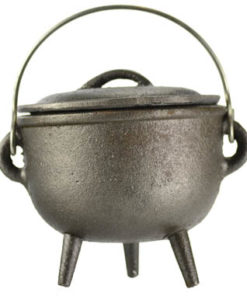


Cast iron cauldron, plain
Price range: $8.75 through $144.05
One of our most popular altar tools · Available in 9 sizes
A plain black cast iron cauldron, the witch’s classic vessel for safely holding fire or water in banishing, burning and scrying.
Quick Uses
- Petitions: burn a paper naming what you want gone and scatter the cold ash at a crossroads or on the wind.
- Loose incense: fill the base with sand, set a charcoal disc on top and burn resins and herbs without scorching your altar.
- Scrying: fill it with water, add a drop of ink and gaze into the dark surface by candlelight.
- Hexing fires: burn a name-paper inside with pepper or graveyard dirt and keep the ash for powders.
How to Use It
Witchcraft & Folk Magick
- Burning petitions: write what you want gone on paper, set it alight from a candle and drop it in the cauldron, then scatter the cold ash at a crossroads or on the wind.
- Loose incense: fill the base with sand, set a charcoal disc on top and burn resins and herbs without scorching your altar.
- Scrying: fill it with water, add a drop of ink, and gaze into the dark surface by candlelight.
Demonology & Black Magick
- Hexing fires: a name-paper is burned in the cauldron with pepper, sulphur or graveyard dirt, and the ash is kept for powders or laid where the target walks.
- Sealed workings: lidded cauldrons are used to cook down or smother a name-paper, the lid closed over the work to keep it contained.
A Simple Working
- Pour a layer of sand into the bottom of the cauldron.
- Write a habit, fear or situation you want to release on a slip of paper.
- Light a black chime candle and read the paper aloud.
- Set the paper alight from the candle and drop it into the cauldron.
- Watch until it is fully burned and say “Gone.”
- When cold, take the ash outside and scatter it away from your home.
Pairs Well With
- Charcoal discs: for burning loose incense in the cauldron.
- Sand: to line the base and protect the iron.
- Black chime candle: for banishing on the same night.
- Parchment paper: for petitions to burn.
What You Receive
Plain black cast iron cauldron, available in 2 1/2″, a 1 3/4″ oval basin-style smudge pot (about 1 3/4″ high x 3″ x 2 1/4″), 3″ in two styles, a 3 3/4″ cauldron/smudge pot, 6″, and lidded versions at 2 3/4″, 3″ and 8″. As cast iron pieces, sizes and finish vary slightly.
Origin & Lore
A cast iron cauldron is a heavy, heat-holding pot, originally made for cooking over open fire. Iron spreads heat evenly and survives direct flame, which is why it was the everyday kitchen pot in Europe for centuries. On the modern altar a small cauldron does the same job: it holds burning charcoal, incense, herbs and paper safely, and holds water for scrying.
The cauldron was the heart of every hearth for centuries, a pot of iron hung over the fire to cook whatever the household had. Folklore never forgot it: the witch at her cauldron is one of the oldest images of the craft.
In Welsh legend the enchantress Ceridwen brewed a potion of wisdom in her cauldron for a year and a day. Three drops splashed onto the thumb of the boy Gwion Bach, who tasted them and gained all knowledge; after a shape-shifting chase, she swallowed him and he was reborn as the great bard Taliesin. The tale is told in the sixteenth-century Hanes Taliesin.
Did You Know?
The Gundestrup cauldron, a richly decorated silver vessel of the Iron Age found in a Danish peat bog in 1891, is covered in images of gods, animals and ritual scenes.
| Weight | N/A |
|---|---|
| Option | 2 1/2", 1 3/4" oval, 3" (style A), 3" (style B), 3 3/4" cauldron/smudge pot, 6", 2 3/4" with lid, 3" with lid, 8" with lid |
Related products