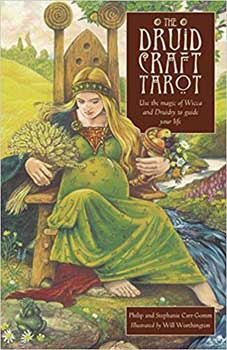
Druid Craft Tarot by Carr-Gomm & Carr-Gomm
$19.79
Wicca and Druidry in One Tarot
A tarot made by practising Druids that joins the Wiccan and Druid streams of Western paganism, chosen by readers who keep the wheel of the year.
Quick Uses
- Sabbat reading: Lay a spread at each of the eight sabbats to read what the coming season holds.
- Seasonal altar: Pick a card that matches the season and keep it on your altar until the next festival.
- Daily draw: Draw one card in the morning and ask how to work with the land that day.
How to Use It
Witchcraft & Folk Magick
- Read at each sabbat of the wheel of the year, setting the card you draw on the altar until the next festival.
- Use a card as the focus of a blessing on home, garden or tools, laid under a green candle.
Ceremonial & Occult Magick
- The deck keeps the traditional structure and elemental suits, so it can sit at the quarters of a cast circle.
- Use the trumps as images for meditation and path-working within a pagan ritual frame.
Demonology & Black Magick
- Read before a working to judge the timing and the forces around you, and again after the spirit is dismissed.
- Ask a spirit to answer through the cards, drawing while its seal lies before you.
- Use the deck to divine which spirit of land or place to approach before making an offering.
A Simple Working
- On the day of a sabbat or the full moon, light a green chime candle.
- Burn a pinch of frankincense and pass the deck through the smoke.
- Lay the four Aces at north, east, south and west.
- Shuffle the rest and draw one card for the centre: the theme of the season ahead.
- Read it with its guidebook entry and write what you plan to do with that knowledge.
- Leave the centre card on your altar until the next festival.
Pairs Well With
- Frankincense: a classic consecration resin for blessing a new deck.
- Green chime candles: for seasonal readings tied to the earth.
- A blank book of shadows: to record the sabbat readings year after year.
- An altar cloth: to lay the four Aces out on at the quarters.
What You Receive
One tarot deck of 78 cards with an 80-page guidebook.
Origin & Lore
Tarot was first a card game in Renaissance Italy and became a tool of divination in eighteenth-century France. Modern pagans took it up widely in the twentieth century, matching its suits to the four elements of the circle.
This deck was created by practising Druids and draws on both Wicca and Druidry, the two main streams of modern Western paganism, with imagery celebrating the earth and the rhythm of her seasons.
Did You Know?
The Hermetic Order of the Golden Dawn, founded in London in 1888, gave tarot the elemental and astrological correspondences that most modern decks, pagan or otherwise, still use.
| Weight | 1.1 lbs |
|---|
Related products