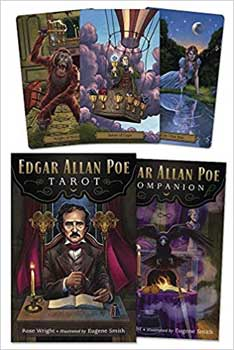
Edgar Allan Poe Tarot by Wright & Smith
$35.19
Rider-Waite-Smith Tarot Meets Poe
A Rider-Waite-Smith-based tarot illustrated from Poe’s tales of mystery and the macabre, chosen by readers who like their divination dark and literary.
Quick Uses
- Raven Spread: Use the guidebook’s Raven Spread when a question keeps coming back to haunt you.
- Gravestone Spread: Lay the Gravestone Spread to see what must be laid to rest.
- Reversals: Practise reading reversed cards with the guidebook’s tips to add depth to your readings.
- Literary study: Read the Poe tale behind a card you keep drawing.
How to Use It
Witchcraft & Folk Magick
- Read at midnight on a winter night with a black candle, in the spirit of “The Raven”.
- Use the Dream Within a Dream Spread before sleep and record what comes in the night.
Ceremonial & Occult Magick
- The deck follows the Rider-Waite-Smith structure, so it works with standard correspondences and significator methods.
- Use a trump card as an image for meditation, holding the scene until it begins to speak.
Demonology & Black Magick
- Poe’s themes of death and the grave suit necromantic work: read before calling on the dead, and ask them to answer through the cards.
- Lay a chosen card under a black candle as the focal image of a binding or banishing working.
- Draw before and after an evocation to judge the timing and the result.
A Simple Working
- At midnight, light a single black chime candle.
- Burn a pinch of wormwood on charcoal and pass the deck through the smoke.
- Speak the name of someone dead you wish to hear from, or of the question that haunts you.
- Lay out the Raven Spread from the guidebook.
- Read each card’s divinatory meaning first, then the Poe tale linked to it.
- Write the answer in your journal and leave the candle to burn out.
Pairs Well With
- Wormwood: a bitter herb long tied to spirit contact and the dead.
- Black chime candles: for a midnight reading in the right mood.
- A black obsidian scrying mirror: for deeper necromantic gazing after the cards.
- A blank journal: to record the spreads and the dreams they bring.
What You Receive
A boxed kit (5.5 x 8) with a 78-card tarot deck and a 288-page colour guidebook. Each card entry has two sections, Into the Maelström for the divinatory meaning and Tell-Tale Heart for its link to Poe’s work, and the book includes guidance on reversals, significators, clarifiers and numerology, with spreads including the Raven Spread, the Dream Within a Dream Spread and the Gravestone Spread.
Origin & Lore
Tarot began as a fifteenth-century Italian card game, and its use for reading fortunes dates from eighteenth-century France. The Rider-Waite-Smith deck of 1909 gave every card an illustrated scene, which is why it can be retold through so many stories.
Here those scenes are drawn from the tales of Edgar Allan Poe, the American master of the macabre, with each card linked to one of his works.
Did You Know?
“The Raven” was first published in January 1845 in the New York Evening Mirror and made Poe famous almost overnight.
| Weight | 2.1 lbs |
|---|
Related products